10 Flight Booking Mistakes Costing You Hundreds
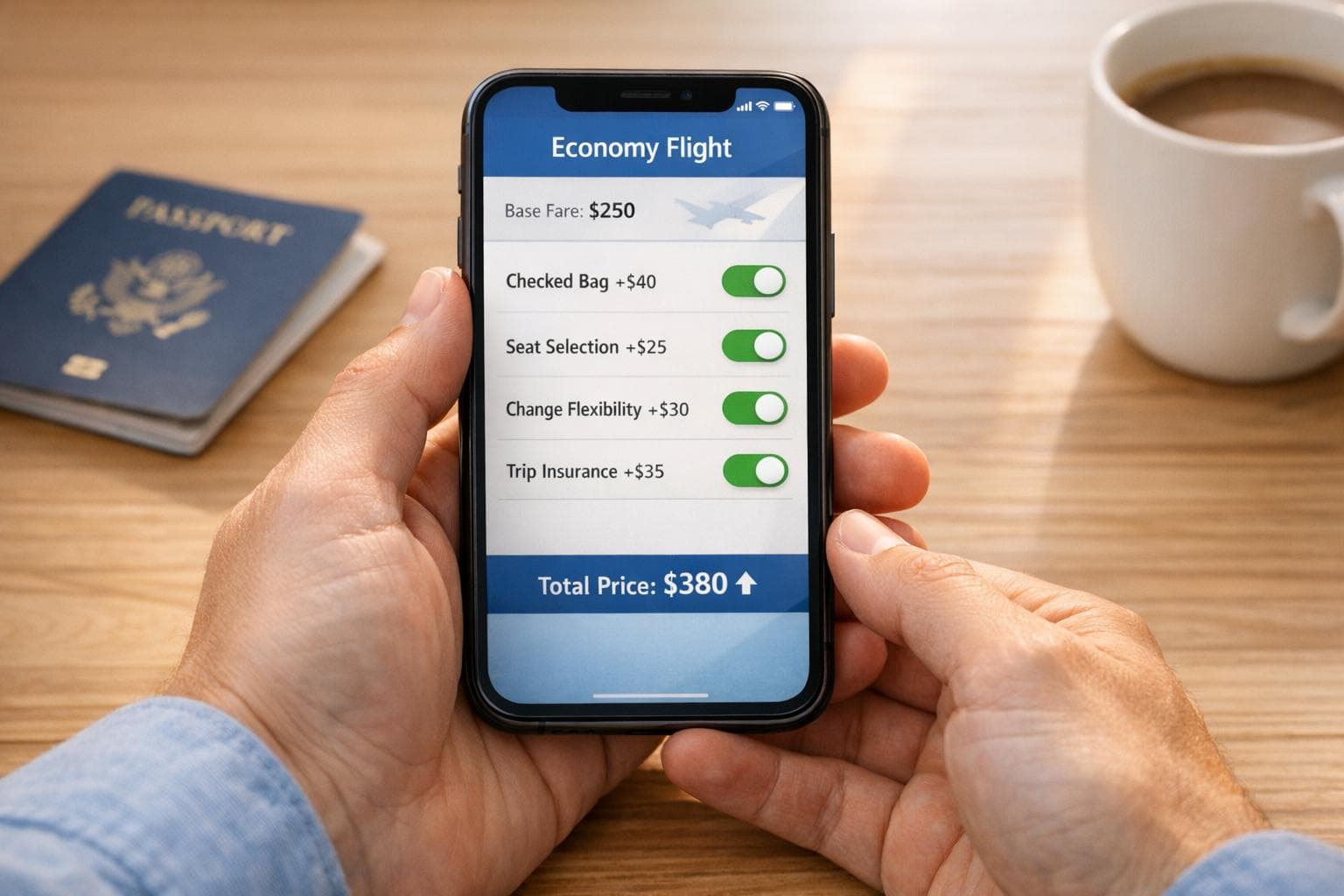
10 Flight Booking Mistakes Costing You Hundreds
Booking flights seems simple, but small mistakes can cost you hundreds. From poor timing to hidden fees, these common pitfalls can inflate your travel expenses. Here's a quick rundown of the key mistakes to avoid:
- Booking too early or too late: Domestic flights are cheapest 30–90 days before departure; international, 60–240 days.
- Flying on weekends: Midweek flights (Tues/Wed) are 12–20% cheaper.
- Rigid travel dates: Flexibility can save 15–40% on fares.
- Skipping early flights: Morning departures are cheaper and have fewer delays.
- Tight connections: Risk missed flights and unexpected rebooking costs.
- Ignoring hidden fees: Baggage, seat selection, and carry-on fees can add 20–40% to your ticket price.
- Not tracking prices: Use tools to catch fare drops and mistake fares (e.g., $171 NYC-Singapore).
- Overlooking nearby airports: Flying from smaller or alternative airports can save hundreds.
- Skipping price comparisons: Prices can vary by $138 across platforms - always check multiple sites.
- Ignoring credit card rewards: Points, miles, and perks can significantly reduce airfare costs.
Key takeaway: Timing, flexibility, and research are your best tools for saving money. Even small tweaks - like flying midweek or booking early morning flights - can make a big difference.
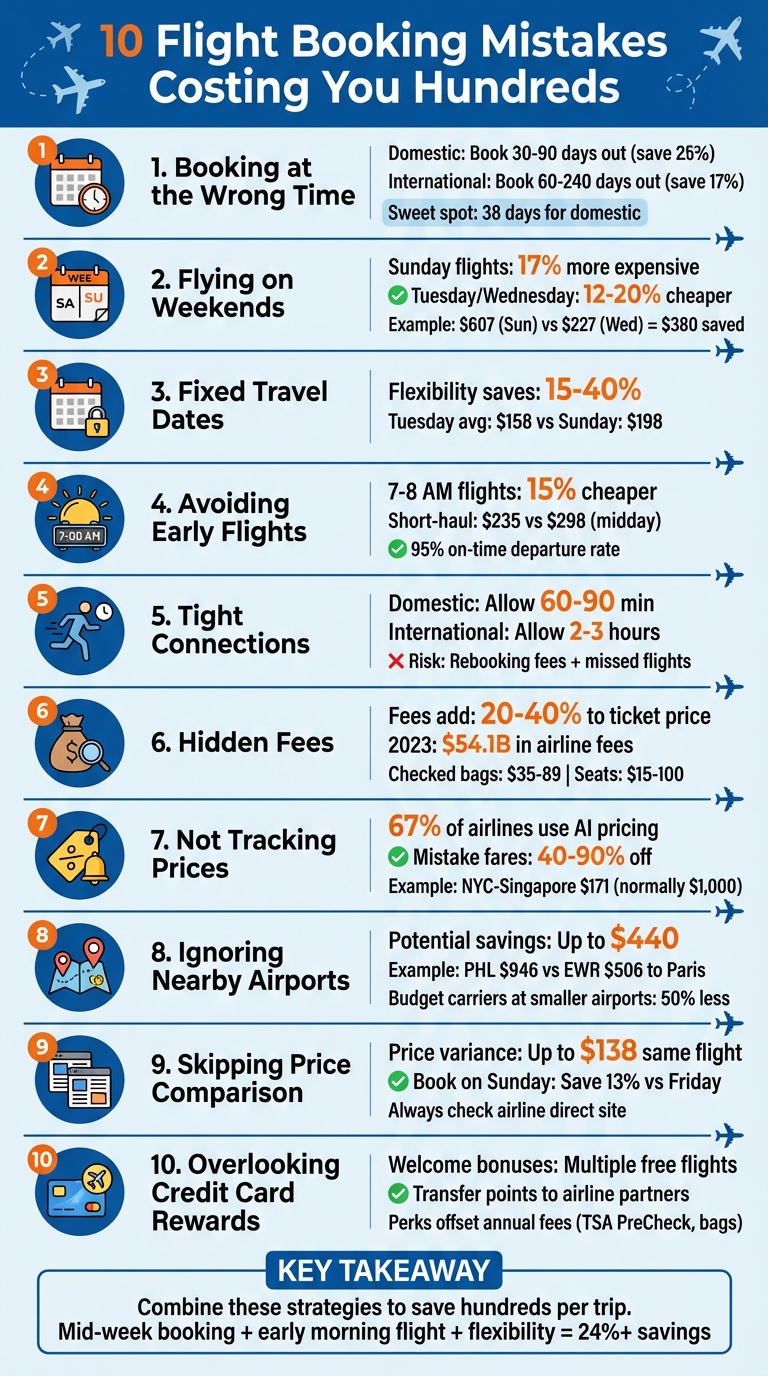
10 Flight Booking Mistakes That Cost You Hundreds - Quick Reference Guide
Top 10 Flight Booking Mistakes & How to Solve Them | 2024 Travel Guide ✈️🚫
sbb-itb-7ea9975
1. Booking at the Wrong Time
When it comes to flight prices, timing can make or break your budget. Airlines rely on dynamic pricing systems that adjust fares based on factors like demand, competition, and seat availability. This creates a "Goldilocks Window" - a sweet spot where ticket prices are at their lowest, steering clear of the inflated rates seen far in advance or the steep hikes of last-minute bookings.
For domestic flights, aim to book 30–90 days before departure, with the lowest fares typically found around 38 days out. For international trips, the ideal booking window is 60–240 days in advance. Following these guidelines can save you about 25% on domestic flights and 17% on international ones.
Booking too early - more than 6–10 months ahead - can lock you into higher prices. On the flip side, waiting until within 21 days of departure often results in a price jump of $100–$200.
Scott Keyes, Founder of Scott's Cheap Flights, explains how airlines handle last-minute pricing:
"Airlines realized... what's going to make the most money is not to slash the price on last-minute flights. It's actually to jack up the price on last-minute flights."
For holiday travel, even earlier planning is necessary. For Thanksgiving or Christmas, book domestic flights 3–5 months ahead and international flights 4–10 months in advance. Another helpful strategy is the "Opposite Season Rule", which suggests securing summer travel deals during the Christmas period, when fewer people are searching for warm-weather destinations.
These timing missteps are just one way travel costs can spiral. Next, take a closer look at your travel dates to avoid other costly mistakes.
2. Flying on Weekends Instead of Weekdays
The day you choose to fly can significantly impact your travel budget. Weekend flights, particularly on Sundays and Fridays, often come with a hefty price tag due to high demand.
Sunday stands out as the priciest day to fly, with fares averaging up to 17% higher than other days. On the flip side, midweek departures - like Tuesdays and Wednesdays - are consistently 12–20% cheaper. For example, a September 2025 study revealed that a Boston-to-Los Angeles flight cost $607 on a Sunday, while the same route was only $227 on a Wednesday, saving travelers a whopping $380.
Jesse Neugarten, Founder and CEO of Dollar Flight Club, sheds light on why this happens:
"Fewer business travelers and weekend vacationers are flying. Airlines drop fares on those days to fill seats that would otherwise go empty. Even shifting your trip by a day can mean saving 15 to 20 percent."
If you can’t avoid weekend travel, consider flying on Saturday for domestic trips or Thursday for international ones. These options not only help you save 15–20% but may also come with shorter security lines.
3. Sticking to Fixed Travel Dates
Setting rigid travel dates often means paying more for flights. Airlines use dynamic pricing systems that adjust ticket prices based on demand. If you're not flexible, you might end up stuck with the priciest options available.
For example, shifting your departure day can make a big difference. Flying on a Tuesday instead of a Friday can save you up to 40%. Domestic flights average $158 on Tuesdays and Wednesdays, compared to $198 on Sundays. For international trips, returning on a Wednesday averages $642, while Saturday returns jump to $921.
Jesse Neugarten, CEO & Founder of Dollar Flight Club, emphasizes the value of flexibility:
"Flexibility is your secret weapon. Adjusting your travel dates, using smart tools, and exploring off-peak seasons can cut costs by hundreds of dollars."
Tools like Google Flights' "Date Grid" or the "+/- 3 days" feature let you compare fares across a range of dates, helping you spot the best deals.
Holiday travel is another area where flexibility pays off. For instance, a Thanksgiving 2024 flight dropped from $618 on November 23 to $333 - a $285 savings. Flying on the actual holiday, such as Thanksgiving or Christmas Day, is often cheaper too, as most people prefer to arrive before the celebrations begin.
Being flexible with your travel dates can lead to significant savings, and the same principle applies when choosing flight times.
4. Avoiding Early Morning Flights
Skipping early morning flights might sound appealing - after all, waking up at 3:00 AM isn't anyone's idea of fun. But avoiding those early departures could be costing you. Flights leaving before 8:00 AM are almost always the cheapest of the day. For example, short-haul flights between 7:00 AM and 8:00 AM average $235.12, compared to $298.14 for mid-day flights - a 15% difference. Long-haul flights show a similar pattern, with early departures costing around $959.87 versus $1,102.88 for later options. That’s a noticeable savings, all for setting an early alarm.
Tim, a flight attendant, shares another compelling reason to choose morning flights: "I'd say 95% of flights in the morning will leave on time". The first flights of the day are less likely to face delays since the planes are already at the gate from the night before, and disruptions haven’t snowballed yet. In contrast, flights after 3:00 PM are 50% more likely to be canceled.
Beyond saving money, early flights come with other perks. Security lines are shorter, planes are freshly cleaned, and crews are well-rested. Plus, morning weather tends to be calmer, reducing turbulence during the flight.
To make those early departures easier, plan ahead. Pack your bags the night before or stay near the airport if needed. Once on board, use the flight time to catch up on the sleep you sacrificed. The combination of lower costs, better reliability, and a smoother overall experience makes that early wake-up call worth it. And don’t forget to double-check your connection times to avoid any additional hiccups.
5. Choosing Tight Connections
After tackling pricing issues related to timing and travel dates, it's important to think about how tight connections can quietly increase your travel costs.
A 35-minute layover might sound efficient, but it comes with a high risk of missed flights and unexpected fees. Airlines determine Minimum Connection Times (MCTs) based on legal liability rather than practical passenger experience. These times assume everything runs perfectly - no delays, no last-minute gate changes. In reality, tight connections often lead to missed flights, rebooking hassles, and extra charges.
The financial impact depends on how you booked your flights. If everything is on a single ticket, the airline will usually rebook you at no extra charge. But if you’re using separate tickets, a missed connection can cause bigger problems. You might be marked as a "no-show", face steep rebooking fees, or even have your second flight canceled entirely. In that case, you’d be stuck buying a last-minute ticket at a much higher price. Loulu Lima, Founder of Book Here Give Here, explains the risk:
"I literally have a waiver that clients have to sign if they want that because the chances of you missing your connection are so high. I don't want to be responsible for that".
Even if you make your connection, your checked luggage might not. If your bags are delayed or lost, you could end up spending extra on essentials at your destination. And if you miss the last flight of the day, you might have to pay for a last-minute hotel stay and meals out of pocket.
International connections are even trickier. You’ll need to clear immigration, collect your bags, pass through customs, re-check your luggage, and go through security again. This process can easily take 45 to 90 minutes or more. Duke Armitage, an airline pilot and Founder of Aviamonde, advises:
"I'd say layovers between connecting flights should be at least 1.5 hour for domestic flights and three hours for international trips".
Just like timing your bookings or choosing the right travel days, allowing for longer layovers is a simple way to avoid unexpected costs.
To minimize these risks, give yourself extra time. For domestic flights, aim for a layover of 60 to 90 minutes. For international connections, plan for 2 to 3 hours, or even longer if you’re on separate tickets - 3 to 4 hours is ideal. If possible, book a seat near the front of the plane to save time deplaning, and stick to carry-on luggage to avoid delays with checked bags. While longer layovers might seem inconvenient, they’re a small price to pay compared to the costs of a missed connection.
6. Ignoring Hidden Fees and Baggage Costs
Hidden fees and baggage charges can quickly turn a seemingly affordable ticket into a much pricier endeavor. Many airlines lure travelers with low base fares but pile on charges for extras. In 2023, the top 10 global airlines made a staggering $54.1 billion from additional fees and ancillary revenue. U.S. airlines alone brought in over $5 billion from baggage fees and another $4.2 billion from seat selection fees in 2024.
As SmarterTravel Editors aptly stated:
"Welcome to modern air travel, where the base fare is just the cover charge".
The gap between the advertised fare and the actual cost can be shocking. To avoid sticker shock, calculate the total cost of your ticket, factoring in all expected fees. Charges for checked bags, seat selection, and even carry-ons can increase your fare by 20–40%. For example, when Southwest Airlines ended its long-standing "bags fly free" policy in May 2025 and introduced assigned seating in January 2026, it projected $1.5 billion in annual revenue from these changes alone. Delta Airlines, on the other hand, earned $7 billion through its American Express partnership in 2024, showing just how much airlines rely on these extra fees.
Here’s a breakdown of common fees to consider when calculating your ticket's real cost:
- Checked bags: $35–$89 per bag
- Carry-ons (budget airlines): $31–$65
- Seat selection: $15–$100 per segment
- Booking fees: Up to $23
These costs can add up quickly, and a survey found that 86% of Americans have faced unexpected airline charges, with 20% spending an extra $100–$200 per trip on hidden fees. Paying for services like baggage or seat selection online is usually cheaper, as fees can nearly double when paid at the airport.
When comparing ticket prices, look beyond the base fare. Budget airlines might appear cheaper upfront but often charge separately for basic services like carry-ons, while full-service airlines may include these amenities in the ticket price. If you travel frequently, consider co-branded airline credit cards, which often waive the first checked bag fee - saving around $70 on a round trip. And remember, most airlines still allow one free personal item that fits under your seat, so pack wisely to avoid extra charges.
7. Not Tracking Prices or Missing Mistake Fares
Flight prices can shift in the blink of an eye, thanks to AI-driven pricing systems. Nearly 67% of airlines now use these systems, which adjust fares in real time. Without actively tracking these changes, you risk missing out on some incredible deals, including the elusive mistake fares.
Mistake fares are essentially pricing errors - caused by typos, technical glitches, currency conversion mishaps, or algorithm hiccups - that lead to tickets being sold at dramatically reduced prices. These rare gems can save travelers anywhere from 40% to 90% off the usual cost. For example, in 2025, Going uncovered jaw-dropping deals like a New York to Singapore flight for just $171 one-way (normally $1,000) and a Seattle to South Korea roundtrip for $359 (typically $1,200). Even business-class flights to Europe have been spotted for as low as $866 roundtrip, compared to the usual $4,000.
The downside? These deals don’t last long. Airlines often catch and correct these errors within minutes or hours. As Scott Keyes, founder of Going, advises:
"The moment you find a mistake fare is the best time to book a flight".
Here’s the good news: About 80–90% of mistake fares are honored by airlines, so acting quickly pays off. Book the ticket immediately and use the 24-hour cancellation window (for flights involving U.S. soil) to sort out your travel plans later. This approach ensures you don’t let a golden opportunity slip away.
Manually hunting for these deals is time-consuming and inefficient. That’s where technology comes in. Services like Tripaway use advanced algorithms to scan millions of flight paths, flagging price drops, mistake fares, and flash sales in real time. Instant alerts mean you can pounce on deals before they disappear. In 2025 alone, deal-tracking services identified 16 mistake fares - double the number from the previous year.
If you snag a mistake fare, follow these tips to maximize your chances of success:
- Book directly with the airline to ensure faster ticket issuance.
- Avoid calling the airline to confirm the deal - this could alert them to the error.
- Hold off on booking non-refundable accommodations or tours for at least two weeks.
While airlines aren’t legally required to honor mistake fares under a 2015 Department of Transportation policy, they must issue a full refund if they cancel the ticket. Fortunately, only about 10–20% of mistake fares are ever canceled. By staying alert and acting fast, you can turn these rare pricing errors into unforgettable travel savings.
8. Failing to Check Nearby Airports
Limiting yourself to just one airport could cost you a significant amount. Flights from nearby airports, even those just a short drive away, can often be much cheaper. For example, in May 2023, travel expert Katy Nastro shared an eye-opening comparison: a roundtrip ticket from Philadelphia (PHL) to Paris in October was priced at $946. Meanwhile, the same trip from Newark (EWR), only about 90 minutes away, cost just $506. That’s a savings of $440 for the exact same destination.
Why the difference? Smaller or secondary airports usually have lower landing fees and facility taxes, which airlines reflect in their ticket prices. Budget carriers like Avelo, Allegiant, Frontier, and Spirit often operate from these airports, offering fares up to 50% less than those at larger hubs.
To find these deals, search using city-wide airport codes instead of specific airport codes. For example, typing "NYC" instead of "JFK" will show flights from JFK, LaGuardia, and Newark all at once. This trick also works for cities like London ("LON"), Los Angeles ("QLA"), or Paris ("PAR"). Once you’ve found a flight, double-check that the extra travel expenses - like gas, tolls, or parking - don’t cancel out your savings.
Speaking of parking, smaller airports often have lower daily rates, typically around $8–$12 per day, compared to $20–$30 at major airports.
Katy Nastro sums it up perfectly:
"Sometimes hitting the road to another, larger airport might be worth the savings of flying out of a smaller, closer airport."
So, when planning your trip, don’t forget to check airports within a 100-mile radius. A short drive could lead to big savings on your airfare.
9. Skipping Price Comparison Across Platforms
Did you know that airfare prices for the same flight can vary by as much as $138 depending on where you book? A study comparing nine travel sites uncovered this surprising gap. If you’re booking on the first site you check, you might be leaving money on the table.
Why does this happen? Airlines use yield management systems to adjust ticket prices based on demand. If their sales projections aren’t met, they might release lower-priced seats about 4 to 6 weeks before departure. On top of that, online travel agencies (OTAs) often tack on extra service, change, or cancellation fees, making the total cost higher than it initially seems. And then there are airlines like Southwest that don’t even list their fares on most third-party sites, meaning you could miss out on their best prices altogether.
To make sure you’re getting the best deal, start with price comparison tools like Google Flights, Skyscanner, or Kayak. These aggregators give you a broad view of ticket prices across platforms. Then, check the airline’s official website - it often offers the same price without the extra fees. Tools like Kayak’s "Fee Assistant" can also help you figure out how baggage fees impact the total cost. What looks like a cheap fare on an OTA might end up being pricier once you factor in those fees.
Booking directly with the airline has another perk: better customer service. If your flight is delayed or canceled, the airline can assist you immediately. But if you booked through an OTA, you’ll have to go through them first, which can be a hassle - especially when you’re stranded at the airport.
Taking the time to compare prices and booking directly when possible can save you from hidden fees and headaches. Plus, timing matters. Booking on a Sunday, for instance, can save you up to 13% compared to booking on a Friday. Christie Hudson from Expedia highlights this:
"Travelers can save up to 13% when making a booking on a Sunday instead of a Friday".
Even small changes like choosing the right booking day can lead to big savings. By carefully comparing platforms and timing your purchase, you can lock in the best fare while staying on top of your cost-saving game.
10. Overlooking Credit Card Points and Rewards
Skipping out on points or miles by paying cash can mean missing significant savings. Travel credit cards have the potential to save you hundreds - or even thousands - of dollars on airfare through welcome bonuses, category rewards, and transferable points. Yet, many travelers either don’t have a card that aligns with their needs or don’t know how to make the most of the rewards they’ve already earned.
The first step to maximizing your rewards is taking advantage of welcome bonuses. These bonuses often require hitting a spending threshold within the first three to six months, but the payoff can be huge - enough for multiple domestic flights or even an international business class upgrade. Cards like the Chase Sapphire Preferred ($95 annual fee) or the Capital One Venture X ($395 annual fee) offer strong earning rates and flexible redemption options. For those willing to pay a premium, the Amex Platinum ($895 annual fee) provides perks like Centurion Lounge access and 5× points on flights booked directly with airlines.
One of the best features of many travel cards is the ability to transfer points. Programs like Chase Ultimate Rewards, Amex Membership Rewards, and Capital One Miles allow you to move points to various airline partners. This not only protects you from devaluations but also expands your redemption options. As Spencer Howard, founder of Straight to the Points, explains:
"Redeeming miles and points is a choose-your-own-adventure game, and you get to decide what you prioritize".
This flexibility lets you customize redemptions to suit your travel goals.
Once you’ve accumulated points, it’s critical to confirm award availability before transferring them to an airline. Some airline websites display “phantom availability,” which shows seats that can’t actually be booked. To avoid this, call the airline to verify availability. Remember, once points are transferred, they can’t be moved back.
Another pitfall to watch for is fuel surcharges. Certain carriers, like British Airways, may tack on fees that can exceed $1,000. Instead, consider using programs like Air Canada Aeroplan or Avianca LifeMiles to book Star Alliance flights without those hefty fees.
Don’t forget about card perks that can offset annual fees. Many travel cards cover Global Entry/TSA PreCheck fees (up to $120), offer free checked bags, or provide travel credits. These benefits can make the card worthwhile, even for occasional travelers. However, carrying a balance on your card can quickly erase any rewards earned, as interest rates typically far outweigh the 1%–2% value of points.
Conclusion
Dodging these 10 common mistakes can help you transform full-price airfare into impressive savings. For instance, flying mid-week instead of on weekends can cut costs by an average of 13%. Similarly, choosing early morning flights not only lowers fares by 2–3% but also reduces the likelihood of delays. By booking at the right time, exploring nearby airports, factoring in hidden fees, and taking advantage of credit card rewards, you could save hundreds on each trip.
The secret to consistent savings lies in using the right tools and strategies. Set up price alerts to catch fare drops as soon as they happen. Use "All Airports" search options to compare prices across nearby locations, and always calculate the total cost - including extras like baggage fees and seat selection - before confirming your ticket. Understanding how airlines price their flights gives you a clear advantage.
Flexibility is your strongest ally when it comes to maximizing savings. Adjusting your travel dates by just a day or two can slash domestic flight costs by up to 24%. Opting for connecting flights over nonstop routes could save you an additional 20%. Even minor tweaks, like choosing an earlier departure time, can make a noticeable difference in your overall travel expenses.
Keep monitoring fares even after booking. Thanks to the 24-hour free cancellation rule, you can rebook if prices drop within that window. Some platforms even offer price-drop protection, automatically refunding the difference so you’re never stuck overpaying.
FAQs
What if flight prices drop after I book?
If the price of your flight drops after you've booked, you might still have ways to save. In the U.S., airlines are required to offer a full refund if you cancel within 24 hours of booking, giving you the chance to rebook at the lower price. Additionally, some airlines or booking platforms provide options to rebook when fares decrease. To stay ahead, set up price alerts to monitor changes and carefully check airline policies to see if you're eligible for refunds or rebooking.
How can I estimate the real total cost including fees?
To figure out the total cost of a flight, make sure you're looking at the final price, which should include extras like baggage fees, seat selection charges, booking fees, and taxes. If you can, prepay for things like baggage - this can save you from unexpected charges at the airport. Double-check that all mandatory taxes and fees are reflected in the final price to avoid any surprises. Comparing these all-in costs across different booking platforms can help you plan more effectively and steer clear of hidden expenses.
How long should my layover be to avoid missing a connection?
If you want to avoid the stress of missing a connection, plan for a layover of at least 1.5 hours for domestic flights and around 3 hours for international flights. This buffer gives you enough time to deal with potential delays and navigate to your next gate without feeling rushed.