Hidden City Ticketing: Risks, Rewards, and Rules
Hidden City Ticketing: Risks, Rewards, and Rules
Hidden city ticketing, or "skiplagging", is a travel trick where you book a flight with a layover at your actual destination, skipping the final leg. Why do it? Savings. For example, a Gainesville to Charlotte direct flight might cost $255, but booking Gainesville to New York (via Charlotte) could cost just $122 - a 52% discount.
But it’s not all smooth sailing. Here’s the quick breakdown:
- Savings: Up to 65% on flights, especially for last-minute trips or major hubs like Chicago or Atlanta.
- Limitations: Only works for one-way tickets. Checked bags? Not an option - they’ll go to the final destination.
- Risks: Airlines cancel future flights, suspend loyalty accounts, and even fine passengers. Advanced AI tools now flag frequent skiplaggers.
- Pro Tips: Stick to carry-ons, avoid frequent flyer accounts, and use this sparingly to stay under the radar.
While tempting, hidden city ticketing violates airline policies and can lead to penalties. If you’re looking for safer ways to save, apps like Tripaway can help you find deals without breaking the rules.
Hidden City Ticketing: What is it? Is it safe? How do you use it?
sbb-itb-7ea9975
How Hidden City Ticketing Works
Hidden City Ticketing Price Comparison: Savings on Major Routes
Step-by-Step Booking Process
Hidden city ticketing takes advantage of pricing quirks in airline routes. Sometimes, a flight from Point A to Point C with a layover at Point B costs less than a direct flight from Point A to Point B - even though the first leg of the journey is identical.
For instance, let’s say you need to fly from Gainesville to Charlotte. Instead of booking a direct flight, you search for flights from Gainesville to destinations beyond Charlotte, such as New York or Boston, that include a layover in Charlotte. If one of these longer routes is cheaper, you book that ticket and simply exit the plane at Charlotte.
Important considerations: Always book one-way tickets and stick to carry-on luggage. If you skip a leg on a round-trip ticket, airlines will cancel the rest of your itinerary. And checked bags? They’ll continue to the final destination listed on your ticket, leaving you stranded without your belongings.
Ben Schlappig, a seasoned travel expert, sheds light on the rationale behind this pricing strategy:
"Airline pricing is incredibly complicated... it has always been based on how much airlines can get away with charging".
By following this approach, travelers can often find significant savings, as shown in the examples below.
Price Comparison Examples
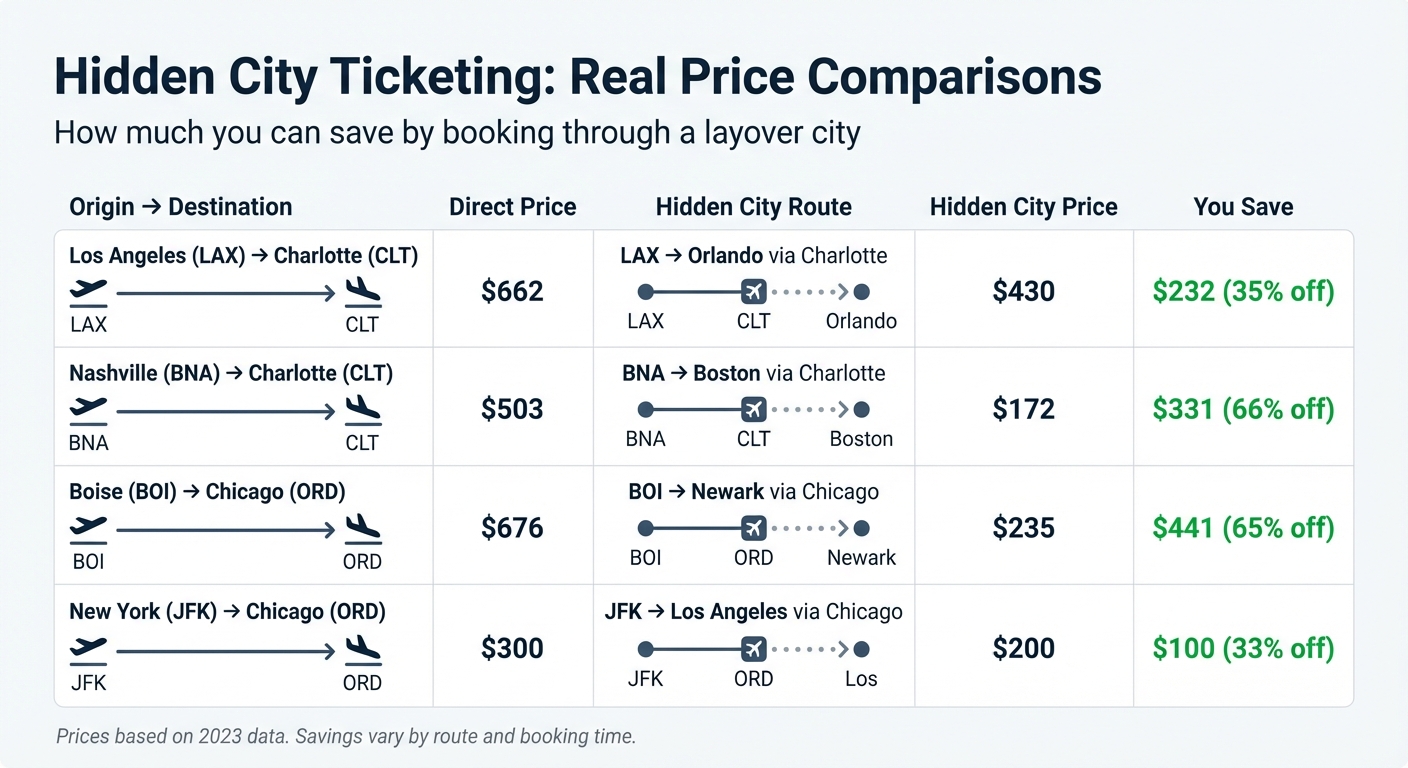
The price differences can be striking. For example, in March 2023, a nonstop flight from Los Angeles to Charlotte cost $662. But booking a flight from Los Angeles to Orlando with a stop in Charlotte brought the price down to $430 - saving $232.
These savings are most commonly found on routes involving major airline hubs like Charlotte, Chicago, Atlanta, and Dallas. Airlines often charge premium prices for direct flights to these cities, making hidden city options a more budget-friendly alternative.
| Origin City | Direct Destination | Direct Price | Hidden City Route | Hidden City Price | Savings |
|---|---|---|---|---|---|
| Los Angeles (LAX) | Charlotte (CLT) | $662 | LAX → MCO via CLT | $430 | $232 |
| Nashville (BNA) | Charlotte (CLT) | $503 | BNA → BOS via CLT | $172 | $331 |
| Boise (BOI) | Chicago (ORD) | $676 | BOI → EWR via ORD | $235 | $441 |
| New York (JFK) | Chicago (ORD) | $300 | JFK → LAX via ORD | $200 | $100 |
Benefits and Drawbacks
Main Benefits
One of the biggest draws of hidden city ticketing is the potential for massive savings. Travelers can save an average of $550 per ticket, and on certain routes, the difference is even more striking. For example, a direct flight from JFK to Amsterdam costs $1,117, but booking a flight to London with a layover in Amsterdam drops the price to $458 - a whopping $659 saved.
This method is especially helpful for last-minute travelers. Direct flights to major hubs often come with hefty price tags, but connecting flights that use those same hubs as layovers bypass those premium fares.
Award tickets see similar benefits. For instance, a business-class flight from Sydney to Los Angeles typically costs 223,000 miles. But by adding a segment to San Antonio, the cost drops to just 71,000 miles - a 65% reduction. On domestic routes, booking through a hub instead of directly to it can save up to 63.4%. These savings extend across various booking methods, making it a go-to strategy for savvy travelers. However, these perks come with some serious limitations.
Practical Limitations
As enticing as the savings are, hidden city ticketing has its challenges. One major drawback is that you can only travel with carry-on luggage. Any checked bags will automatically continue to the final destination on your ticket, leaving you without your belongings [5,7]. If overhead bins fill up and you're forced to gate-check your carry-on, it will also be sent to the final destination [5,9].
This method works only for one-way trips or the last leg of a round trip. Skipping a segment causes airlines to cancel any remaining flights on your ticket [5,9]. Weather delays or mechanical issues can also result in rerouting, which might bypass your intended stop altogether [5,9]. Additionally, you’ll need proper documentation, such as a passport or visa, for the final destination listed on your ticket - even if you have no intention of going there [5,7].
Here’s a quick breakdown of the upsides and downsides:
| Advantage | Disadvantage |
|---|---|
| Save around $550 per ticket on average | Limited to carry-on luggage (no checked bags) |
| Reduce award bookings by up to 65% | Only works for one-way tickets |
| Access cheaper routes to hub cities | Risk of rerouting during delays |
| Great for last-minute travel | Requires documents for the final destination |
| Leverage competitive pricing on connecting flights | Airlines may suspend loyalty accounts |
Risks and Airline Rules
What Can Go Wrong
Hidden city ticketing might seem like a clever way to save money, but the potential downsides can be severe. If you skip a segment of your flight, the airline will cancel any remaining flights on your itinerary - including return trips. This policy is strictly enforced.
The financial consequences can be steep. For example, Lufthansa once sued a passenger for €2,112 (about $2,362), American Airlines imposed a $1,315 fee and threatened a permanent ban, and United Airlines charged a $500 penalty for similar violations.
Frequent flyer accounts are also at risk. Airlines often suspend accounts, revoke elite status, and confiscate earned miles if they catch passengers repeatedly using this tactic. Between 2024 and 2025, American Airlines flagged one AAdvantage member for 52 instances of hidden city ticketing, locking the account and demanding financial restitution before considering reinstatement.
The airlines’ enforcement doesn’t stop there. In 2025, American Airlines won a $94 million lawsuit against Skiplagged, a website known for promoting hidden city ticketing. Additionally, major airline alliances now share blacklists of flagged passengers, meaning a ban from one airline could limit your ability to fly with others in the same network. And if you’re thinking travel insurance or credit card protections will cover you, think again - most policies explicitly exclude coverage for issues tied to hidden city ticketing.
How Airlines Detect and Respond
Airlines have become highly adept at spotting hidden city ticketing. Advanced algorithms can flag unusual travel patterns within minutes. For instance, American Airlines uses AI tools to monitor social media for discussions about hidden city strategies, while Delta Air Lines introduced specialized tracking software in early 2025 to catch offenders.
Gate agents are trained to spot red flags as well. In one case from July 2023, American Airlines detained a teenager in Charlotte, North Carolina, after noticing his local driver's license didn’t match his ticketed destination of New York City. His ticket was canceled on the spot, and his family had to buy a full-price replacement flight. Similarly, in April 2024, United Airlines issued a memo instructing gate agents to question suspected skiplaggers and even close frequent flyer accounts for violators.
Airlines justify these measures by claiming that skipping flight segments disrupts operations and impacts seat availability for other passengers. An American Airlines spokesperson emphasized this point, highlighting the operational challenges hidden city ticketing creates.
Beyond gate-level scrutiny, airlines also analyze booking histories for irregular patterns. If you repeatedly end your trips at layover points instead of the final destination, it could trigger an audit. This is made even easier by the fact that the four largest U.S. carriers - American, Delta, Southwest, and United - control 80% of domestic air travel, allowing them to enforce these rules across the industry.
How to Use Hidden City Ticketing Safely
Tips for Reducing Risk
If you're considering hidden city ticketing, taking precautions is essential to avoid potential penalties and complications.
First, always book one-way tickets. Airlines cancel the remaining legs of your trip if you skip a segment, so round-trip bookings can lead to cancellations. For return trips, purchase separate one-way tickets to avoid disruptions.
Stick to carry-on luggage only - and consider paying for early boarding to secure overhead bin space. Checked bags are routed to the final destination on your ticket, which makes retrieving them at your layover nearly impossible without raising red flags.
"Never check your bags. You do not want your bags to end up at your ticketed final destination." – Nick Reyes, Author, Frequent Miler
Avoid linking your frequent flyer account to hidden city bookings. Airlines track travel patterns through loyalty programs, and they may penalize you by revoking miles or elite status if they suspect fare abuse. Using this strategy sparingly can also help reduce the risk of detection. As Ben Schlappig, founder of One Mile at a Time, explains:
"I think it's fairly low risk if you do it on occasion, aren't crediting flights to a frequent flyer program, etc. However, if you do this frequently, expect that it'll catch up to you".
For international routes, ensure you have the necessary visas and passport for the ticketed final destination, even if you plan to disembark earlier. Airlines often check these documents before boarding. When possible, stick to domestic routes to avoid immigration-related complications.
By following these steps, you can reduce risks and make hidden city ticketing a safer option.
Finding Hidden City Routes with Tripaway
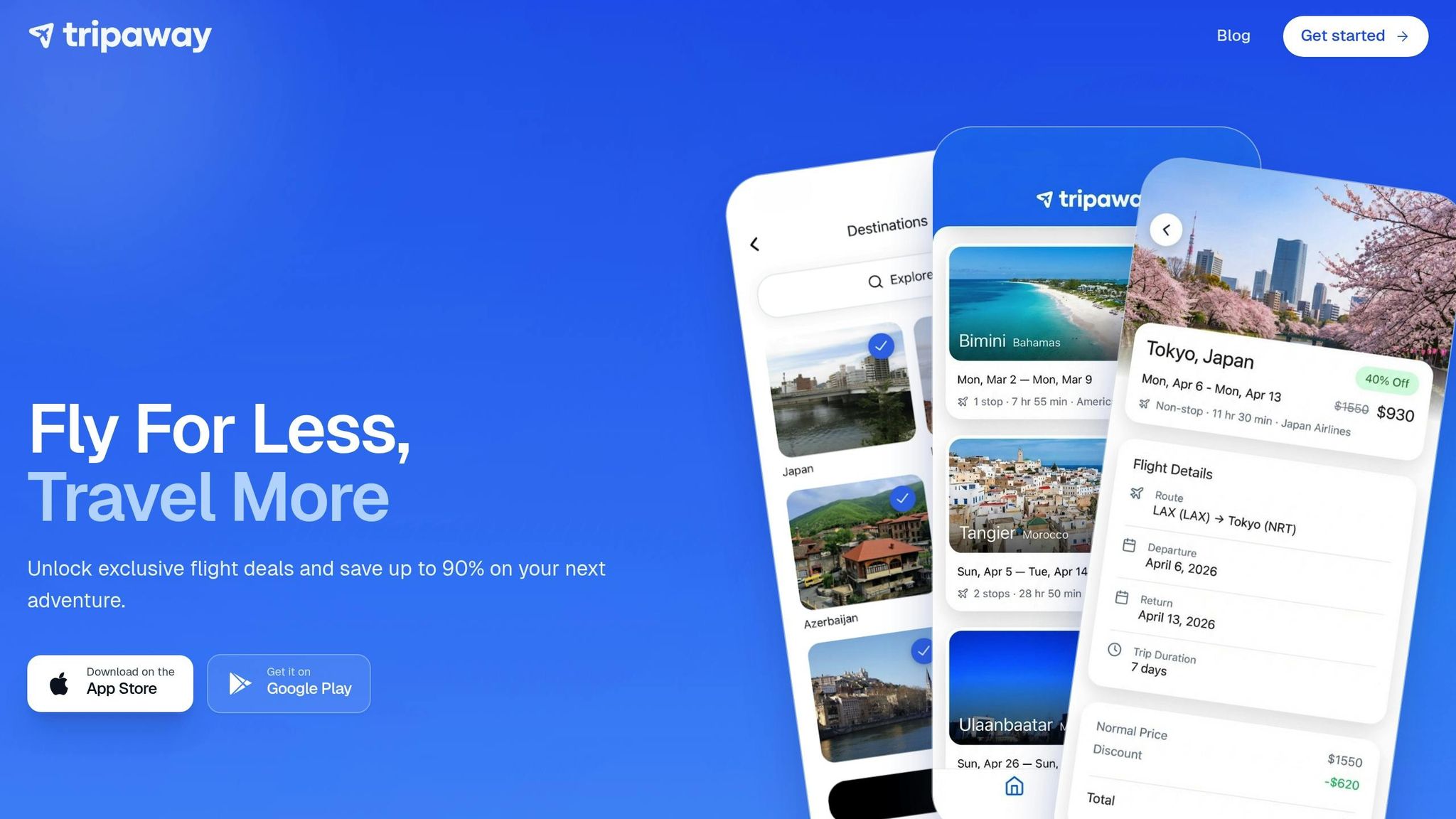
Finding the right deal is just as important as following safe practices. Tripaway simplifies the process by identifying pricing anomalies that make hidden city ticketing worthwhile.
With its Premium Plan, Tripaway helps users uncover hidden city opportunities, mistake fares, and flash sales. The app scans millions of flight paths to pinpoint routes where connecting flights are significantly cheaper than direct ones. Plus, customizable alerts for U.S. airports make it easier to find deals where the layover city matches your intended destination.
Tripaway can help you save 40–90% on airfare, demonstrating why hidden city ticketing appeals to savvy travelers.
Final Thoughts
Hidden city ticketing can slash airfare costs by up to 65% on certain routes, but it comes with serious risks. This practice violates the airline's Contract of Carriage, taking advantage of pricing loopholes, and airlines are quick to spot irregular booking patterns. The consequences? You could face account suspensions, lose frequent flyer miles, be banned from the airline, and even miss out on protections from travel insurance or credit cards.
Unexpected disruptions, like rerouted flights, are also a real possibility. As Ben Schlappig from One Mile at a Time explains:
"Paying for a flight and then skipping a segment isn't like going to a restaurant and not finishing your meal. There can be consequences".
If you decide to try this method, stick to one-way tickets, avoid checking luggage, and don’t link your loyalty accounts. And even then, use this strategy sparingly to reduce the risk of being flagged.
For those looking to save money on flights without stepping into risky territory, Tripaway offers a solid alternative. The app tracks legitimate price drops, mistake fares, and flash sales, helping users save 40–90% without breaking airline rules. With its Premium Plan, Tripaway scans millions of flight options and sends tailored alerts for U.S. airports, making it simple to snag great deals.
Want to save safely? Let Tripaway do the work and find deals that won’t put you at odds with airline policies.
FAQs
Is hidden city ticketing illegal or just against airline rules?
Hidden city ticketing isn’t against the law, but it usually breaks the rules set by airlines. Most carriers explicitly ban this practice in their contract of carriage. If they catch someone using it, they might enforce penalties. In some cases, airlines have even taken legal action against passengers who attempt it.
What happens if my carry-on gets gate-checked on a hidden city itinerary?
If your carry-on bag gets gate-checked during a hidden city itinerary, it might end up at the final destination listed on your ticket. This can be a problem if you plan to leave the trip at an earlier stop, as you won’t have access to your bag. To avoid this, make sure all essential items are packed in your personal bag that stays with you.
How can I lower the chances of being rerouted past my intended layover city?
To avoid the hassle of being rerouted away from your planned layover city, opt for flights with direct routes or fewer connections leading to your layover destination. Steer clear of itineraries with multiple layovers or routes that are known for frequent changes. Since airlines occasionally adjust their routes, it's smart to stay updated on their policies and keep an eye on your flight status. This can help you anticipate and reduce the chances of unexpected detours.