7 Ways to Save Money on International Flights

7 Ways to Save Money on International Flights
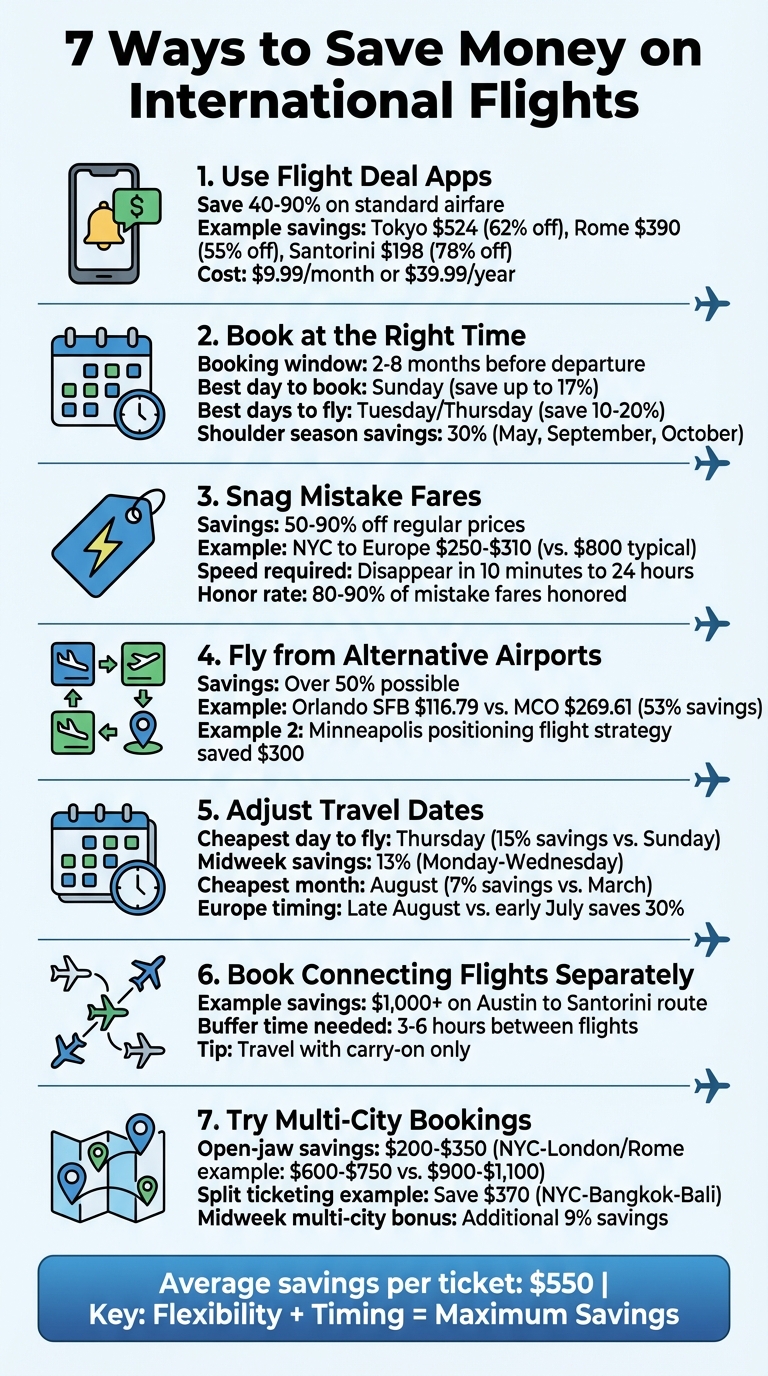
Flying internationally doesn’t have to break the bank. With rising airfare costs, smart strategies can help you save hundreds. Here's what you need to know:
- Use Flight Deal Apps: Apps like Tripaway alert you to price drops, mistake fares, and flash sales, saving up to 90% on tickets.
- Book at the Right Time: The "Goldilocks Window" (2–8 months before departure) is ideal. Sundays often have the best deals, while flying midweek can cut costs by 10–20%.
- Snag Mistake Fares: Airlines occasionally list tickets at huge discounts due to pricing errors. Act fast - these deals disappear quickly.
- Fly from Alternative Airports: Smaller or nearby airports often have cheaper flights. Positioning flights can also help you combine deals.
- Adjust Travel Dates: Flying on Thursdays or midweek, and avoiding peak seasons, can save up to 30%.
- Book Connecting Flights Separately: Self-transfers or "hacker fares" can reduce costs but require careful planning.
- Try Multi-City Bookings: Open-jaw tickets let you visit multiple cities for less than round-trip fares.
Key Takeaway
Flexibility and timing are your best tools to save on international flights. Use apps, adjust dates, and explore alternative routes to find the best deals.
7 Proven Strategies to Save Money on International Flights
You’re Overpaying for Flights (Here’s How to Stop)
sbb-itb-7ea9975
1. Use Flight Deal Discovery Apps Like Tripaway
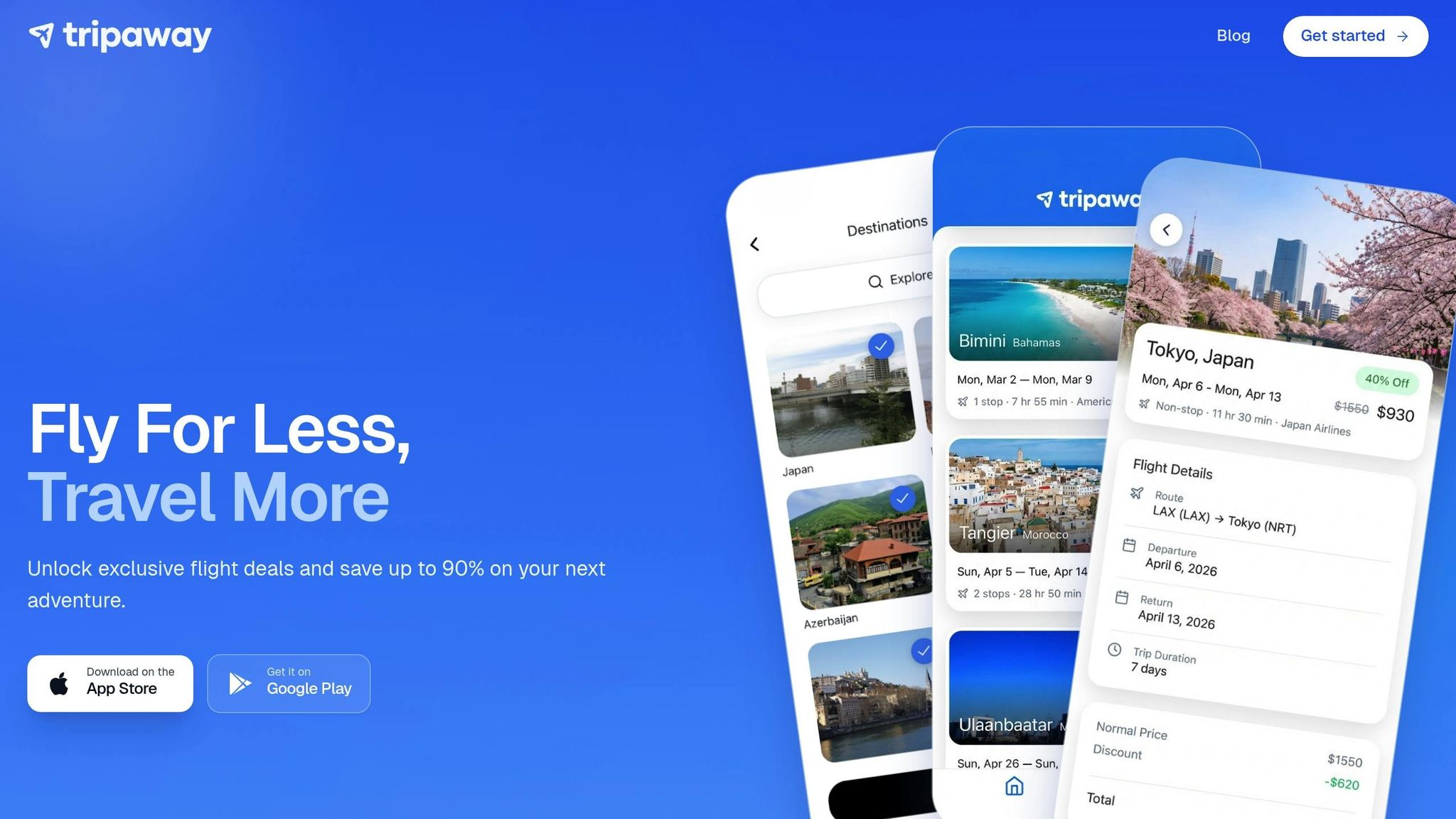
Flight deal discovery apps are a game-changer for saving money on international flights. These apps continuously monitor millions of routes to spot price drops, mistake fares, and flash sales that often disappear within hours. Instead of manually checking multiple airline websites, you'll get instant alerts when deals pop up.
Tripaway is one of the top players in this space, scanning flights from U.S. airports and sending deals straight to your phone. For example, in September 2025, users snagged a Tokyo round-trip on JAL for just $524 (62% off). Other standout deals included Rome for $390 (55% off) and Santorini for $198 (78% off). On average, users save between 40% and 90% on standard airfare by acting quickly on these alerts.
Cost Savings Potential
Tripaway’s algorithm is designed to catch error fares and flash sales, turning what could be four-digit ticket prices into surprisingly affordable options. With plans starting at $9.99 per month or $39.99 annually, the app often pays for itself after just one discounted booking.
Ease of Use
Getting started is simple. Download the app, choose your departure airports, and you’ll receive a personalized feed of deals. The app’s smart grouping feature keeps everything organized, so you don’t have to worry about fare classes or complicated routing. If a mistake fare pops up, book it immediately - airlines typically honor tickets purchased before they correct the error.
Perfect for Frequent Travelers
If you’re a regular international traveler, Tripaway is a must-have. With over 100 daily deals from airports worldwide, it ensures you’re always in the loop about steep discounts. You can even track multiple departure airports simultaneously, making it easier to catch deals that fit your schedule. This app is a solid starting point for building smarter travel booking habits.
2. Book at the Right Time
The timing of your booking can make a huge difference in how much you pay for international flights. Experts recommend booking during the "Goldilocks Window", which is typically 2 to 8 months before your departure. Booking too early - more than 10 months ahead - might not help, as airlines often set higher initial prices. On the other hand, waiting until the last minute, especially within 14 to 21 days of your flight, usually results in steep price increases.
Sunday is the best day to book your flights. Research shows that booking on a Sunday can save you up to 17% on international airfare. Melanie Fish from Expedia Group Brands highlights that booking too far in advance can cost more due to those early high fares. Timing matters not just for when you book but also for when you fly, as even small adjustments can lead to noticeable savings.
Cost Savings Potential
When it comes to saving money, the day you travel is just as important as the day you book. Flying midweek - especially on Tuesdays or Thursdays - can reduce fares by 10% to 20%. If you're planning to travel during busy seasons like summer or the holidays, aim to book 4 to 10 months in advance. For other trips, booking 18 to 29 days before departure might save you up to 17%, compared to booking more than three months ahead. Traveling during shoulder seasons - May, September, and October - can cut costs by as much as 30% compared to peak travel times.
Ease of Implementation
To make the most of these tips, set a reminder to search and book flights on Sunday afternoons. Use price alert tools to track fares during the ideal 2- to 8-month booking window, and prioritize midweek departures when possible. If you're traveling to specific regions, keep these timelines in mind:
- Europe: Book 5–8 months in advance
- Asia: Book 3–5 months in advance
- Mexico/Central America: Book 2 weeks to 6 months in advance
Suitability for Frequent Travelers
If you travel internationally often, these strategies can help you save a lot over time. By mastering when to book and when to fly, you can consistently reduce your travel expenses across multiple trips throughout the year.
3. Take Advantage of Mistake Fares
Once you've nailed down the best timing for booking flights, there's another smart way to save big: mistake fares. These pricing errors can slash ticket prices dramatically, but you need to act fast to benefit.
Mistake fares happen when airlines accidentally list tickets at much lower prices than intended. These errors can cut ticket costs by as much as 50% to 90%. For example, in 2025, travelers scored roundtrip flights from New York to European cities like Vienna, Prague, and Munich for just $250–$310 in economy class - a massive drop from the usual $800 price tag.
However, these deals don’t last long. They can disappear within 10 minutes to 24 hours, so speed is essential. Interestingly, airlines honor most mistake fares - about 80% to 90% - because canceling them in bulk can lead to bad press and extra costs. Going.com tracked 16 mistake fares in 2025, more than twice the number reported in 2024.
Cost Savings Potential
The savings from mistake fares can be jaw-dropping. In 2025, a roundtrip flight from Seattle to South Korea was available for just $359 - a 70% discount off the typical $1,200 fare. Even business class travelers can find incredible deals. Back in 2018, Hong Kong Airlines honored a mistake fare for roundtrip transpacific business class flights from Los Angeles or San Francisco to Asia for only $561.
How to Snag Mistake Fares
To make the most of mistake fares, tools like Tripaway’s real-time alerts can be a game-changer. Once you spot a deal, book it directly on the airline’s website. This ensures your ticket is issued quickly, increasing the likelihood that the airline will honor the fare.
Paying with a credit card is another smart move. If the airline cancels the fare, credit card refunds are usually processed within seven days, compared to about 20 days for other payment methods. One key tip: don’t call the airline to confirm a mistake fare. Highlighting the error could lead them to cancel the deal altogether.
Flexibility Is Key
Taking advantage of mistake fares requires a bit of flexibility. When you spot a deal, you’ll need to book immediately - sometimes within minutes. However, hold off on locking in non-refundable hotels or tours for at least two weeks to avoid potential headaches if the fare is canceled. As Scott Keyes, Founder of Going, wisely puts it:
"Mistake fares are the cherry on top, delightful when they happen, not something you build a sundae around".
These deals often come with specific dates and destinations, so being spontaneous is your best bet for scoring these incredible savings.
4. Fly from Different Airports
Looking to slash ticket costs even further? Consider flying from alternative airports. Switching to smaller or less popular airports can save you over 50% on airfare. These savings often come from lower operating costs at these airports, which translate into reduced landing fees and taxes - benefits passed directly to you.
Cost Savings Potential
Here's a standout example: in Orlando, flying out of Sanford International (SFB) costs an average of $116.79 for a round trip, compared to $269.61 at Orlando International (MCO). That's a difference of more than 50%.
Kyle Potter, Executive Editor of Thrifty Traveler, shared a great case in February 2026. A traveler from Minneapolis-St. Paul saved nearly $300 on a trip to Copenhagen by combining flights. Instead of booking a single ticket from Minneapolis, they booked a $356 round-trip flight from Boston on Scandinavian Airlines and added a $153 positioning flight from Minneapolis to Boston on Sun Country. The total? Just $509 - far less than the $800+ cost of booking directly from Minneapolis.
This strategy works for international travel too. Dollar Flight Club highlighted one example where a $249 flight from New York to Budapest was paired with a $43 local flight to Amman, Jordan. The total? $292 - much cheaper than the $603 direct flight to Amman.
Ease of Implementation
Finding these deals does take some effort, but tools like Google Flights make it simpler. Use multi-airport city codes like NYC (covers JFK, LGA, and EWR) or LON (includes LHR, LGW, and STN) to search all nearby airports at once. Google Flights even allows you to compare fares from up to five airports simultaneously, streamlining the process.
However, don’t forget to calculate the true cost of your trip. This includes ground transportation, parking fees (ranging from $5–$12 per day at smaller airports versus $20–$30 at major hubs), and the time it takes to travel to and from alternative airports.
"Positioning flights make any flight deal accessible from anywhere in the U.S. Don't let another incredible flight deal pass you by because it's not departing from your home city."
- Kyle Potter, Executive Editor, Thrifty Traveler
Flexibility Required
This strategy does demand some flexibility. You might need to drive 50–100 miles to reach a different airport or handle self-transfers between separate bookings. For international connections, allow at least 3–4 hours between flights, since airlines won’t cover missed connections on separate tickets.
Traveling light is key here - stick to carry-on luggage to avoid the hassle of re-checking bags during self-transfers. And if you’re flying into a hub city for a connection, consider arriving a day early to avoid potential delays.
5. Adjust Your Travel Dates
Tweaking your departure or return dates by just a day or two can make a big difference in ticket prices. For international flights, Thursday tends to be the cheapest day to fly, while Sunday is often the most expensive. In fact, flying on a Thursday instead of a Sunday could save you around 15% on your airfare.
Cost Savings Potential
Traveling midweek - Monday through Wednesday - can save you about 13% compared to flying over the weekend.
"Flying midweek can save you nearly $100 off your ticket. So when you're thinking about when you want to travel, try shifting your dates midweek versus flying over the weekend." - Lindsay Schwimer, Consumer Travel Expert at Hopper
The time of year also plays a role in pricing. August stands out as the cheapest month for international travel, offering savings of up to 7% compared to March. For those heading to Europe, timing can be crucial - postponing your trip from early July to late August could cut costs by nearly 30%. These examples show how a little flexibility with dates can lead to significant savings.
Ease of Implementation
Tools like Google Flights' "Date Grid" or "Price Graph" make it simple to identify cheaper travel dates. These visual tools allow you to spot the best deals quickly. You can also set up monthly price alerts to track fare drops.
Flexibility Required
This strategy works best if your schedule allows for some wiggle room. Start by searching for the cheapest dates, then plan your trip around those. Pair this with other strategies, like choosing flights during low-demand periods. Early morning or late-night flights are often more affordable, as fewer people prefer those times. Additionally, flying on major holidays - such as Thanksgiving Day, Christmas Day, or New Year's Day - can be cheaper than traveling the days just before or after. Flexibility is key to making the most of these savings.
6. Book Connecting Flights Separately
Want to save on airfare? Consider booking your connecting flights separately. Known as "self-transfer" or "hacker fares", this method lets you combine budget airlines with traditional carriers in ways standard bookings don’t allow. Take travel reporter Katherine Fan, for instance. In July 2019, she needed to get from Austin to Santorini for a wedding. A single-ticket itinerary would have cost $3,800. Instead, she booked a cheap flight from Austin to Frankfurt and then a separate ticket from Frankfurt to Greece, saving a significant amount.
Cost Savings Potential
The savings can be impressive. Back in 2016, Katherine Fan spotted a $250 mistake fare to New Zealand from Los Angeles. Instead of booking a $1,284 direct flight from Austin, she used a Southwest Airlines award ticket to get to Los Angeles and then took advantage of the $250 fare, saving over $1,000. Similarly, travel expert Scott Keyes found a $130 roundtrip mistake fare from New York to Milan. To make it work, he took a $20 bus from Washington D.C. to New York, avoiding an $800 direct fare from D.C..
Ease of Implementation
This strategy isn’t hard to pull off, but it does require careful planning. Make sure to leave 3–6 hours between international flights to account for delays, baggage collection, security checks, and any visa or immigration requirements. Traveling with carry-on luggage can also simplify things and help you avoid baggage delays.
Flexibility Required
One downside of booking separate tickets is that you’re on your own if something goes wrong. For instance, if your first flight is delayed and you miss the second, the airline won’t rebook you for free - you’ll need to buy a new ticket. To protect yourself, consider travel insurance that specifically covers missed connections on separate tickets. It’s worth noting that even a 30-minute delay can cause 40% of self-connecting passengers to miss their next flight.
"Self-transfer offers freedom with a side of responsibility, but I think it's worth it because I can put the savings toward enjoying my vacation." - Lily Cichanowicz, Writer, KAYAK
This strategy pairs well with other money-saving tips and opens up options for multi-city itineraries, giving you more flexibility in planning your travels.
7. Try Multi-City Bookings
If you're looking to save money and explore more destinations, multi-city bookings are worth considering. These tickets allow you to visit multiple cities on a single itinerary, often costing less than a traditional round-trip ticket. Airlines use intricate pricing systems that sometimes favor these routes over simpler ones. The trick lies in booking an "open-jaw" ticket - flying into one city and out of another - so you can skip the hassle of returning to your starting point.
Cost Savings Potential
Multi-city bookings can lead to substantial savings. For instance, an open-jaw ticket from New York City to London with a return from Rome might cost $600–$750, compared to $900–$1,100 for a standard round-trip, saving you $200–$350. Another example is split ticketing. A single ticket from NYC to Bangkok to Bali might cost $1,100, but booking NYC to Bangkok for $650 and then using a budget airline for Bangkok to Bali at $80 brings your total to $730 - saving $370. Depending on the route, you could save anywhere from $200 to $500 by planning smartly.
Ease of Implementation
Booking multi-city itineraries has never been easier. Most travel websites now include a "multi-city" search option, simplifying the process of comparing routes. Additionally, many airlines offer affordable stopovers at their hub cities. For instance, Icelandair lets you add a 7-day stopover in Reykjavik on an NYC to London route for just $50 more ($650 versus $600). Airlines like TAP Air Portugal, Qatar Airways, and Turkish Airlines have similar programs, making it easy to add extra destinations to your trip.
Flexibility Required
To make the most of multi-city bookings, you’ll need some flexibility. Adjusting your travel dates or flying midweek can significantly lower costs - midweek flights, for example, save about 9% on international routes. Booking all legs on one ticket ensures the airline will rebook you if delays cause missed connections. However, if you're piecing together separate tickets to save more, allow a 4–6 hour buffer between flights and be prepared to handle any issues yourself. Always secure your flights before arranging accommodations or car rentals to align everything with the best travel dates.
Suitability for Frequent Travelers
Frequent travelers often prefer multi-city bookings because they save time and eliminate unnecessary backtracking. Booking these routes on a single ticket also ensures airlines will rebook your entire trip if disruptions occur. For those collecting miles, sticking to one airline alliance - like Star Alliance or Oneworld - can maximize rewards. Just avoid "hidden city" ticketing tricks, as they can result in penalties on loyalty accounts.
Conclusion
Saving money on international flights isn't just about luck - it takes a mix of strategy and flexibility. The seven methods outlined here work best when combined, rather than used on their own. A great starting point? Let flight prices dictate your travel dates. As Kyle Potter, Executive Editor at Thrifty Traveler, puts it:
"The key to finding cheap flights is to... let the prices you see on the monthly calendars guide you to the cheapest dates possible".
Even small adjustments can lead to big savings. For example, shifting your travel dates or opting for midweek flights can significantly lower fares. Booking flights within the ideal 2- to 8-month window also helps you avoid those painful last-minute price hikes. These small moves can save you hundreds of dollars per ticket.
Flexibility goes beyond dates. Being open to alternative airports, layovers, or multi-city routes can unlock even more savings. The "Flight First Rule" is a game changer here: always book your flights before locking in hotels or rental cars. This keeps your options open for snagging the best deals. Plus, the federal 24-hour cancellation rule gives you a safety net while sorting out the rest of your trip.
Tools like Tripaway make the process even easier. By monitoring millions of routes and alerting users to price drops, mistake fares, and flash sales, Tripaway users save an average of $550 per ticket. With airlines using advanced AI to adjust prices constantly, relying on manual searches alone just doesn’t cut it anymore.
FAQs
How do I avoid getting stuck if a self-transfer goes wrong?
To steer clear of problems with self-transfers, a little preparation goes a long way. Give yourself extra layover time to account for potential delays. Double-check the visa requirements for any layover countries - you don’t want to get caught off guard. Be ready to pick up and recheck your luggage between flights, and keep an eye on flight updates so you’re always in the loop.
Since airlines won’t help you rebook missed connections on self-transfer flights, it’s smart to look into travel insurance. It can help cover unexpected delays or missed connections. A bit of planning can make your journey much smoother.
When should I book flights versus hotels and tours?
Booking flights before hotels and tours is a smart move. Why? Because flight prices tend to increase as your travel date gets closer. For international trips, snagging tickets 3–6 months in advance often means better deals. On the other hand, accommodations and tours are usually more flexible, giving you the option to book them closer to your departure. This way, you can focus on securing affordable flights first and plan the rest of your trip around them.
How can I tell if a fare is a real deal or a mistake fare?
To identify a mistake fare, keep an eye out for typos, currency mix-ups, or unexpected price drops. Tools like flight alerts or comparison websites can help you track these fares effectively. Compare the price against the usual rates for that route to confirm if it’s unusually low. If you spot one, act fast - airlines honor mistake fares roughly 70% of the time, but they tend to fix these errors quickly. It’s also worth checking if the airline has a reputation for honoring such fares.