Google Flights vs Skyscanner: Which Finds Better Deals?
Google Flights vs Skyscanner: Which Finds Better Deals?
When it comes to booking flights, Google Flights and Skyscanner are two of the most popular tools. Each platform has strengths and weaknesses, making them better suited for different types of travelers. Here's the core takeaway:
- Google Flights is great for speed, price accuracy, and searching fares from major airlines. It’s ideal for domestic U.S. flights, last-minute bookings, and users who value a clean, fast interface. Tools like the Price Guarantee (up to $500/year refund for fare drops) and Price Insights make it a reliable choice for straightforward searches.
- Skyscanner excels at finding budget airlines and fares from smaller booking sites, often uncovering options Google Flights misses. It’s best for international travel, multi-city itineraries, and flexible travelers using features like the "Everywhere" search or Cheapest Month view.
Key Differences:
- Google Flights: Faster searches, better price transparency, fewer "ghost fares" (8.3%), and strong integration with airline websites.
- Skyscanner: Broader airline coverage, includes ultra-low-cost carriers, but more prone to "ghost fares" (11.6%) and price jumps at checkout.
Quick Comparison
| Feature | Google Flights | Skyscanner |
|---|---|---|
| Search Speed | Faster (less than 2 minutes) | Slower (3–5 minutes refresh cycle) |
| Airline Coverage | Major airlines, 300+ partners | Budget airlines, smaller OTAs |
| Price Accuracy | Higher (12.4% price jumps at checkout) | Lower (19.7% price jumps) |
| Flexible Search | "Explore Map" and "Date Grid" | "Everywhere" and "Cheapest Month" |
| Phantom Fares | 8.3% frequency | 11.6% frequency |
| Multi-City Support | Up to 5 legs | Up to 6 legs |
For the best results, use both platforms: Start with Google Flights to set a baseline price, then check Skyscanner for budget options or smaller OTAs. Together, they’ll help you find the best deals for your next trip.
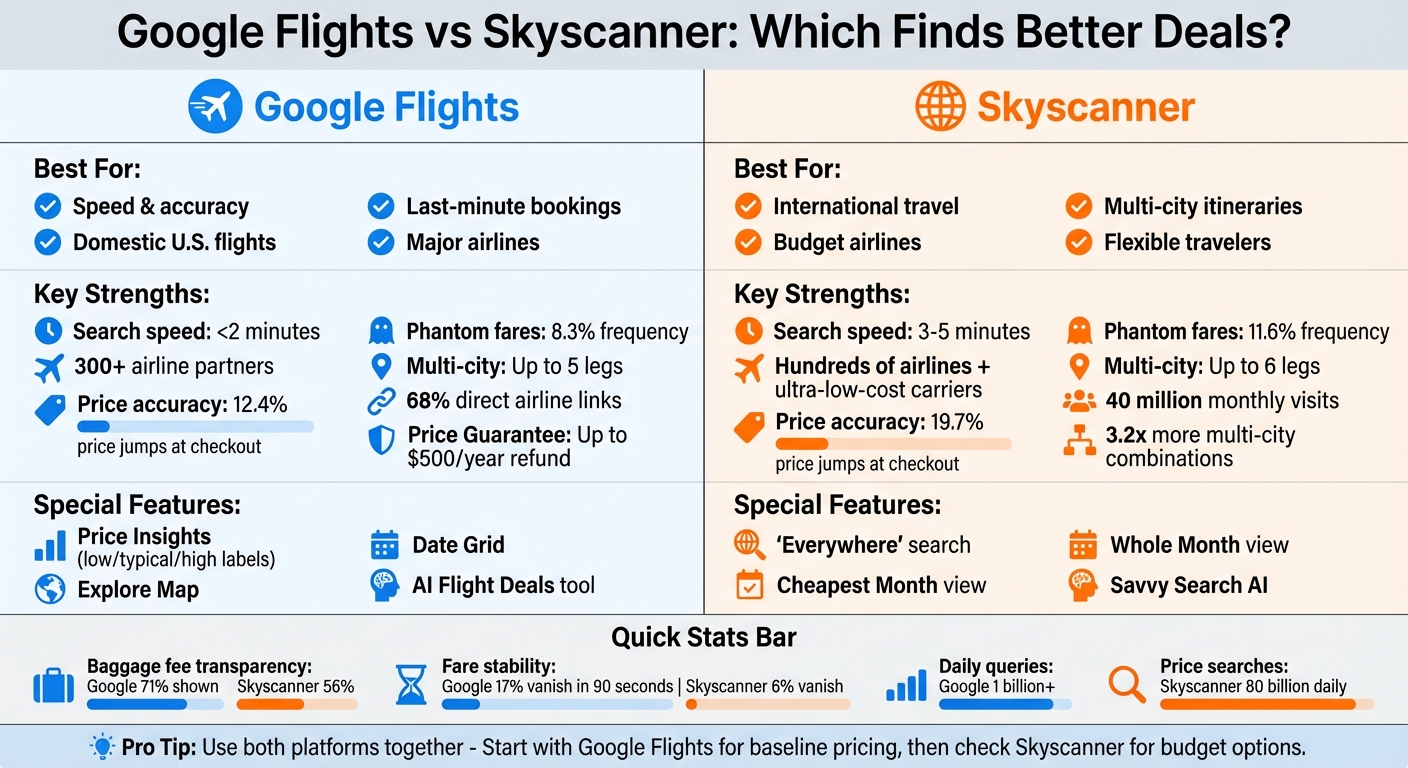
Google Flights vs Skyscanner: Feature Comparison and Performance Metrics
Skyscanner vs Google Flights (2026) - Which One Is BETTER?
sbb-itb-7ea9975
Google Flights Overview
Google Flights is a flight search tool that gathers pricing and schedule data from over 300 travel partners. While it doesn't handle ticket sales directly, it redirects users to an airline's website or a trusted booking platform to complete the purchase. By using real-time data, it delivers accurate and fast results, focusing on major airlines and alliances. Flights are categorized into two groups: "Best" flights, which balance cost with convenience, and "Cheapest" flights, which prioritize the lowest fares.
The service is free to use, and travel partners don't pay for placement, ensuring unbiased results. These core features lay the groundwork for the tools and benefits discussed below.
Key Features of Google Flights
Google Flights comes packed with tools designed to help travelers find affordable flights quickly. For instance, its interactive calendar highlights the cheapest travel dates across the next 12 months. The Price Graph tracks long-term fare trends, while the Explore Map allows users to check flight prices to multiple destinations without committing to one.
The platform supports searches across up to seven airports simultaneously and offers price insights by labeling fares as "low", "typical", or "high" based on historical data.
In 2025, Google introduced an AI-driven Flight Deals tool that uses plain-language inputs to suggest personalized itineraries. Another standout feature is the Price Guarantee program, which promises refunds of up to $500 for fare drops on certain U.S. routes, paid via Google Pay. As James Byers, Group Product Manager at Google, explained:
"When you book one of these flights, we'll monitor the price every day before takeoff, and if the price does go down, we'll pay you back the difference via Google Pay."
Additionally, Google Flights now includes Southwest Airlines fares, though bookings must still be completed on Southwest's website. The platform also integrates with Google's broader ecosystem, such as Google Gemini, enabling conversational flight searches and itinerary planning.
These features make Google Flights a reliable tool for finding flights with speed and pricing clarity.
Strengths of Google Flights
One of the platform's standout qualities is its speed - search results load almost instantly, filters work seamlessly, and the interface is clean and distraction-free. Google Flights also excels in price transparency, clearly showing baggage fees and seat selection costs upfront, so travelers know the total cost before booking. Scott Keyes, Founder of Going, summed it up well:
"Google Flights is like your personal airfare assistant".
Another strength is its reliable booking links. The platform prioritizes "deep links" that take users directly to the airline or booking page, avoiding the frustration of having to re-enter flight details or encountering "ghost fares" that no longer exist.
Limitations of Google Flights
Despite its many advantages, Google Flights does have some drawbacks. Its focus on major airlines and large online travel agencies (OTAs) means it may miss out on ultra-low-cost carriers or smaller international booking sites that sometimes offer steep discounts or mistake fares. For example, a 2025 price comparison for a Lagos-to-Dubai route found Google Flights $45 more expensive than the regional site Aviasales.
Additionally, because Google Flights doesn't handle bookings directly, users must always click through to another site to finalize their purchase. This extra step can feel less convenient compared to platforms offering one-click booking options.
Skyscanner Overview
Skyscanner is a flight search engine that pulls pricing data from hundreds of airlines and online travel agencies (OTAs), directing users to complete bookings on partner sites. Since its launch in 2001, Skyscanner has grown to serve over 100 million users each month, processing over 80 billion price searches daily [16,18].
Unlike Google Flights, which tends to focus on major airlines, Skyscanner takes a broader approach. It frequently uncovers deals from ultra–low-cost carriers like Ryanair, Wizz Air, and AirAsia, as well as smaller international OTAs that other platforms may overlook.
The platform is free for travelers, generating revenue through commissions when bookings are made via its partners. Scott Keyes, founder of Going, highlights its strength:
"Skyscanner is often able to find the lowest flight prices because it searches smaller OTAs that other search engines neglect."
With nearly 40 million monthly visits, Skyscanner has become a trusted tool for travelers looking to compare fares extensively.
Here’s a closer look at what makes Skyscanner stand out.
Key Features of Skyscanner
One standout feature is the "Everywhere" search, which allows users to discover the cheapest destinations worldwide from their departure airport without specifying a location. Flexible date tools, such as "Whole Month" and "Cheapest Month", make it easy to find the best times to travel. For complex trips, the multi-city search supports up to six flight legs, simplifying itinerary planning [16,18].
Other useful tools include the option to search flights from an entire country rather than a specific airport and filters for stops, travel duration, airline alliances, and even CO₂ emissions for eco-conscious travelers. Skyscanner also offers price alerts via email or push notifications, so users can monitor fare changes for specific routes. Its "Savvy Search" feature, powered by AI, provides personalized travel recommendations based on pricing trends and destination data. Additionally, the platform rates OTAs on a 1-to-5 star scale, considering factors like price accuracy, customer service, and user feedback.
Strengths of Skyscanner
Skyscanner’s ability to include budget airlines and smaller booking platforms is one of its biggest strengths. While Google Flights often prioritizes major carriers, Skyscanner goes further, covering regional low-cost airlines and international OTAs that frequently offer cheaper fares, particularly for travel across Europe, Southeast Asia, and Latin America.
Its flexible search tools are another major advantage. The "Everywhere" feature and country-level search options make it easy to explore a wide range of destinations without manually entering multiple cities or airports. Travel expert Nomadic Matt praises the platform, saying:
"Out of all the search engines I've used, Skyscanner is my all-time favorite. It always seems to find the best deals more often than the other websites."
Other notable strengths include transparency around booking partners, thanks to its OTA rating system and "Recommended Provider" badges, as well as a mobile app that is praised for its user-friendly interface and integrated price alerts [16,19].
However, no platform is without its flaws.
Limitations of Skyscanner
Despite its extensive search capabilities, Skyscanner has a few drawbacks. A common issue is "ghost fares" - prices that appear in search results but change or disappear when users attempt to book. A 2024 audit found ghost fares in 11.6% of searches, especially with low-cost carriers. Price accuracy is another concern. Unlike Google Flights, which updates fares almost in real time, Skyscanner’s monthly calendar view relies on historical data, which may not always reflect current prices, particularly for less-popular routes. These inconsistencies can be frustrating for budget-conscious travelers.
Another downside is slower load times compared to Google Flights. With so many OTAs in its search results, the platform can feel less streamlined. Travelers should also be cautious about hidden fees - budget carriers often exclude baggage, seat selection, and meals from their initial prices. It’s always a good idea to double-check the final cost on the airline’s official website before completing a booking.
Feature Comparison: Google Flights vs Skyscanner
Now that we’ve explored what each platform offers, let’s put them side by side and see how they compare in areas that matter most to travelers.
Comparison Table: Key Features and Functions
Both Google Flights and Skyscanner bring their own strengths to the table, but they differ in how they handle searches, display prices, and connect users to booking options.
| Feature | Google Flights | Skyscanner |
|---|---|---|
| Search Speed | Less than 2‑minute latency | 3–5 minute refresh cycle |
| Airline Coverage | Over 300 airlines and OTAs, focusing on major carriers | Hundreds of airlines, including ultra‑low‑cost carriers and smaller OTAs |
| Multi‑Airport Search | Up to 7 departure and 7 destination airports simultaneously | Search by entire countries instead of specific cities |
| Flexible Destination | "Explore Map" shows visual prices to various regions | "Everywhere" search lists cheapest countries or cities |
| Price Accuracy | 12.4% of searches show higher prices at checkout | 19.7% of searches show price jumps at checkout |
| Phantom Fares | 8.3% frequency | 11.6% frequency |
| Fare Stability | 17% of live fares vanish within 90 seconds | 6% vanish during checkout |
| Baggage Fee Transparency | Omitted in 29% of results | Omitted in 44% of results |
| Multi‑City Support | Supports up to 5 flight legs | Supports complex multi‑leg itineraries |
| AI Features | "Flight Deals" accepting plain‑English requests | "Savvy Search" for personalized recommendations |
| Carbon Emissions | Displays CO₂ estimates with filter options | Includes "Greener Choice" labels and emission filters |
Google Flights handles over 1 billion queries daily and updates prices every 15–30 minutes, making it the quicker choice for real-time data. On the other hand, Skyscanner’s broader coverage often uncovers deals from budget airlines that Google might not include.
Let’s dive deeper into how these features shape the user experience.
User Experience and Interface
Each platform offers a distinct approach to navigation and usability, catering to different user preferences.
Google Flights stands out for its clean, ad-free design that delivers results in seconds. Its "Explore Map" and live-updating 2-month calendar make it easy to spot pricing trends at a glance. You can even pick departure and return legs separately, though this flexibility sometimes leads to price changes during checkout.
Skyscanner, while offering more features, has a data-heavy interface that can slow down load times. The mobile web version occasionally struggles with filter resets, but the dedicated app generally performs better. According to Travel And Tour World Editorial, "Google Flights remains the fastest and most user-friendly research tool", though Skyscanner is often preferred by travelers prioritizing comprehensive airline coverage.
Search Flexibility and Customization
Both platforms offer advanced search tools, but their focus and execution differ.
Google Flights excels at detailed filtering. You can refine results by layover durations, connecting airports, and even carbon emissions. A baggage policy filter helps you avoid unexpected fees by showing fares that include carry-ons or checked bags. If you’re tracking prices, tools like the "Date Grid" and "Price Graph" make it simple to identify the cheapest travel dates.
Skyscanner’s standout feature is its "Everywhere" search, which lets you explore the cheapest destinations globally without committing to a specific airport. You can even search for flights departing from an entire country. As Scott Keyes, founder of Going, notes:
"Skyscanner's 'Everywhere' search is one of its standout features. Instead of choosing a destination, you select 'Everywhere' and see the cheapest countries or cities you can fly to".
For flexible travelers, Skyscanner’s "Whole Month" and "Cheapest Month" views are incredibly handy, though they rely on cached data that may not reflect real-time prices for less popular routes.
In a December 2024 test, Google Flights found a fare of $282 for a Las Vegas to Cabo San Lucas route, while Skyscanner displayed $324, highlighting Google’s edge in granular filtering for specific routes. However, in a May 2024 search from London to Lisbon, Skyscanner surfaced a TAP Air Portugal fare for £102 that Google Flights missed, which only showed an easyJet option for £119.
These examples show how the choice between these platforms ultimately depends on what you value most - speed, coverage, or customization.
Search Accuracy and Deal-Finding Performance
Let’s dive deeper into how pricing accuracy influences deal-finding performance. While neither Google Flights nor Skyscanner always delivers the absolute lowest fare, the real question is which platform consistently provides more accurate final pricing.
Accuracy of Pricing Information
Google Flights pulls its pricing data from airlines and major OTAs using Global Distribution Systems. This setup ensures a solid foundation for baseline prices. However, about 12.4% of searches still end with a higher final cost due to hidden fees.
Skyscanner, on the other hand, takes a broader approach. It scrapes airline websites and partners with budget carriers, which expands its reach but comes with a downside: 19.7% of searches result in price increases during checkout. This makes "ghost fares" (prices that vanish or change during booking) more common on Skyscanner compared to Google Flights.
"Aggregators optimize for visibility, not veracity. A '$299' tag that converts at 3.2% is more valuable than a '$312' tag that converts at 0.7% - even if the latter reflects reality."
– Dr. Lena Ruiz, Economist, International Transport Forum
Transparency around baggage fees is another weak spot for both platforms. To avoid surprises, always click through to the final payment page to confirm the total cost before booking.
These pricing inconsistencies highlight why comparing real-world deal performance is so important.
Examples of Deal Performance
Real-world examples shed light on these discrepancies. In October 2024, Sarah searched for flights from Seattle to Tokyo, planning 14 weeks ahead. Google Flights initially quoted $1,389 for an ANA flight, which later increased to $1,501. Meanwhile, Skyscanner showed a JAL flight at $1,299, but after adding baggage and check-in fees, the price jumped to $1,478. Ultimately, Sarah booked the ANA flight for $1,129 using price alerts - $412 less than Google Flights’ original quote.
A larger study of 12,748 searches found that while 18% of searches displayed identical base fares across both platforms, only 6% resulted in the same final price after taxes and fees were factored in. The lesson? Use Google Flights to get a baseline price, then check Skyscanner for the same dates - you might find a smaller OTA or budget carrier offering a better deal.
Price Tracking and Flexible Search Tools
The real advantage of travel platforms isn’t just in one-time searches - it’s in their ability to monitor prices over time and offer tools for exploring options when your travel plans are flexible.
Price Alerts and Notifications
Google Flights allows you to track fares for specific dates - or even for "any dates" - on a route. It sends email updates when prices drop below your original search threshold. What makes this feature stand out is the Price Insights tool, which categorizes fares as "low", "typical", or "high" based on historical trends. This helps you decide whether to book immediately or hold off.
For select U.S. routes, Google Flights also offers a Price Guarantee program. If the fare drops after you book, Google refunds the difference - up to $500 per calendar year per account - as long as the price decrease is at least $5.
Skyscanner, on the other hand, provides "Get Price Alerts" via email or social media. It monitors prices across a broader range of online travel agencies (OTAs) and budget airlines. However, it’s worth noting that Skyscanner is more prone to "ghost fares" - prices that disappear or increase at checkout. When you receive an alert, it’s a good idea to click through immediately to confirm the actual price.
"Google Flights is best for speed, accuracy, and major airlines, while Skyscanner is better for budget carriers and international variety."
– Scott Keyes, Founder, Going
For the best of both worlds, use Google Flights to set price alerts for major airlines and establish a baseline for fares. Then, cross-check with Skyscanner to see if smaller OTAs or ultra-low-cost carriers like Ryanair offer a better deal. Both platforms complement each other well, especially for tracking price drops and exploring flexible travel options.
Flexible Search Options
Once you’ve tracked price trends, it’s time to explore travel dates and destinations. Both platforms offer tools to help you find the most affordable options when your plans aren’t set in stone.
Google Flights includes a Date Grid and Price Graph, which show day-by-day fare changes over a two-month window. These tools make it easy to pinpoint the cheapest travel dates at a glance. Additionally, the Explore Map lets you visualize prices for various destinations within your chosen timeframe. You can even search up to seven origin and destination airports simultaneously to uncover the best regional fares.
Skyscanner takes a slightly different approach with its Whole Month and Cheapest Month views. These tools allow you to see pricing trends across an entire month or identify the most affordable month to travel. This feature is particularly helpful for finding low fares worldwide, regardless of your destination.
For example, a March 2026 test on a New York (JFK) to London (LHR) route for July 15–29, 2026, revealed some key differences. Skyscanner initially displayed a fare of $479, but hidden fees caused the price to jump to $502 at checkout. Meanwhile, Google Flights consistently showed $492. This underscores the importance of verifying final prices on both platforms before committing to your booking.
When to Use Google Flights vs Skyscanner
Use Google Flights for quick and straightforward searches; opt for Skyscanner when hunting for the lowest international fares. Knowing when to use each platform can simplify your travel planning and help you save money.
Best Scenarios for Google Flights
Google Flights shines when you're short on time and need a no-fuss experience. It's particularly effective for domestic U.S. flights or trips with major carriers like Delta, United, or American Airlines. With 68% of results linking directly to airline websites, it ensures accurate pricing and smooth booking. Plus, it leads on 71% of last-minute routes (flights within three days of departure), often showcasing lower fares for U.S. travelers.
If your travel dates are flexible, Google Flights' Date Grid and 12-month Fare View Calendar make it easy to spot the cheapest travel periods. It also offers eco-friendly filters for those who prioritize greener travel options. On select U.S. routes, you might even benefit from their price guarantee feature.
Best Scenarios for Skyscanner
Skyscanner is your go-to for finding the absolute lowest prices, especially for international trips. It includes ultra-low-cost carriers and smaller booking agencies, which means you'll often see discounted fares that Google Flights misses. In fact, non-partner airlines appear 3.2 times more often on Skyscanner. For intra-European flights booked 3–6 months in advance, Skyscanner offered the lowest median fare 63% of the time.
For example, in May 2024, a traveler searching for a London-to-Lisbon flight found a £119 fare on Google Flights with easyJet. However, Skyscanner uncovered a £102 option with TAP Air Portugal, which wasn’t listed on Google since TAP doesn’t participate in the Direct Bookings Program. Skyscanner also excels at handling complex itineraries, offering 3.2 times more multi-city combinations than Google Flights. And if you're open to different destinations, the "Everywhere" search tool can help you discover the cheapest options. During testing in 2026, Skyscanner outperformed on advance-purchase fares 75% of the time.
"Google Flights is best for speed, accuracy, and major airlines, while Skyscanner is better for budget carriers and international variety."
– Scott Keyes, Founder, Going
To get the most out of these tools, start with Google Flights to determine typical prices and the best travel dates. Then, cross-check those dates on Skyscanner to see if smaller carriers or online travel agencies have a better deal. Just be sure to double-check the final price at checkout for any hidden fees.
These strategies will help you navigate both platforms effectively as you plan your next trip.
Conclusion
Google Flights and Skyscanner each bring their own strengths to the table, but neither platform is the perfect fit for every scenario. Google Flights shines with its speed, clean interface free of ads, and dependable pricing, especially for domestic U.S. routes and major airlines. Its price guarantee, which offers refunds up to $500 per year, and the ability to book directly with airlines make it a convenient choice for travelers who value simplicity and strong customer service support.
On the other hand, Skyscanner casts a wider net, often listing smaller online travel agencies and ultra-low-cost carriers that Google Flights might miss. In testing, Skyscanner found the cheapest fare on more than half of the routes compared, making it an excellent tool for budget-conscious travelers. With about 40 million monthly visits compared to Google Flights' 8.9 million, it’s the most visited global flight search engine. However, this broader reach has its downsides, like "ghost fares", more ads, and the need to carefully research third-party booking sites.
The key takeaway? These platforms work well together. Start with Google Flights to quickly identify the best travel dates and establish a baseline price using its intuitive calendar view. Then, check Skyscanner to see if a budget airline or smaller travel agency offers a lower fare. For instance, in October 2025, Google Flights, Hopper, and Priceline all showed the lowest LAX–JFK fare at $398, while Skyscanner listed a slightly higher option at $438. Testing across various routes consistently highlighted price differences, proving the value of comparing both tools.
Ultimately, your choice depends on what matters most to you. For quick domestic bookings and direct airline reservations, Google Flights is a top pick. But if you’re hunting for the lowest international fare and don’t mind vetting third-party options, Skyscanner could uncover deals that others miss.
"Use Google Flights for speed, clarity, and price confidence. Use Skyscanner for variety, budget airlines, and international depth. Together, they cover far more ground than either does alone."
– Scott Keyes, Founder, Going
FAQs
Why do flight prices change between search results and checkout?
Flight prices often shift between your initial search and the final checkout. This happens for a few reasons: airlines adjust fares dynamically, prices update in real-time, or personalized pricing kicks in based on user data. These changes are typically fast, driven by shifts in demand, seat availability, or airline algorithms.
How can I avoid hidden fees like bags and seats when comparing fares?
When booking flights, don’t stop at the initial ticket price you see on search platforms - it often doesn’t tell the whole story. Airlines may tack on extra charges for things like checked bags, seat selection, or even priority boarding. To avoid surprises, take a moment to review the airline’s baggage policies and any additional fees directly on their website. Many platforms only show base fares, so comparing the total cost - including all those extras - is the best way to know exactly what you’ll pay before hitting the “book” button.
Which platform is better for international multi-city trips?
When planning international multi-city trips, Skyscanner often stands out. Its ability to uncover hidden deals and provide flexible search options makes it a solid choice, especially for complex itineraries. Plus, it includes smaller airlines and low-cost carriers in its searches, which can be a game-changer for budget-conscious travelers.
On the other hand, while Google Flights is great for speed and price tracking, it falls short in covering lesser-known airlines and routes. This limitation can make it less ideal for finding affordable options for multi-city international travel.