10 Mistakes to Avoid with Travel Rewards
10 Mistakes to Avoid with Travel Rewards
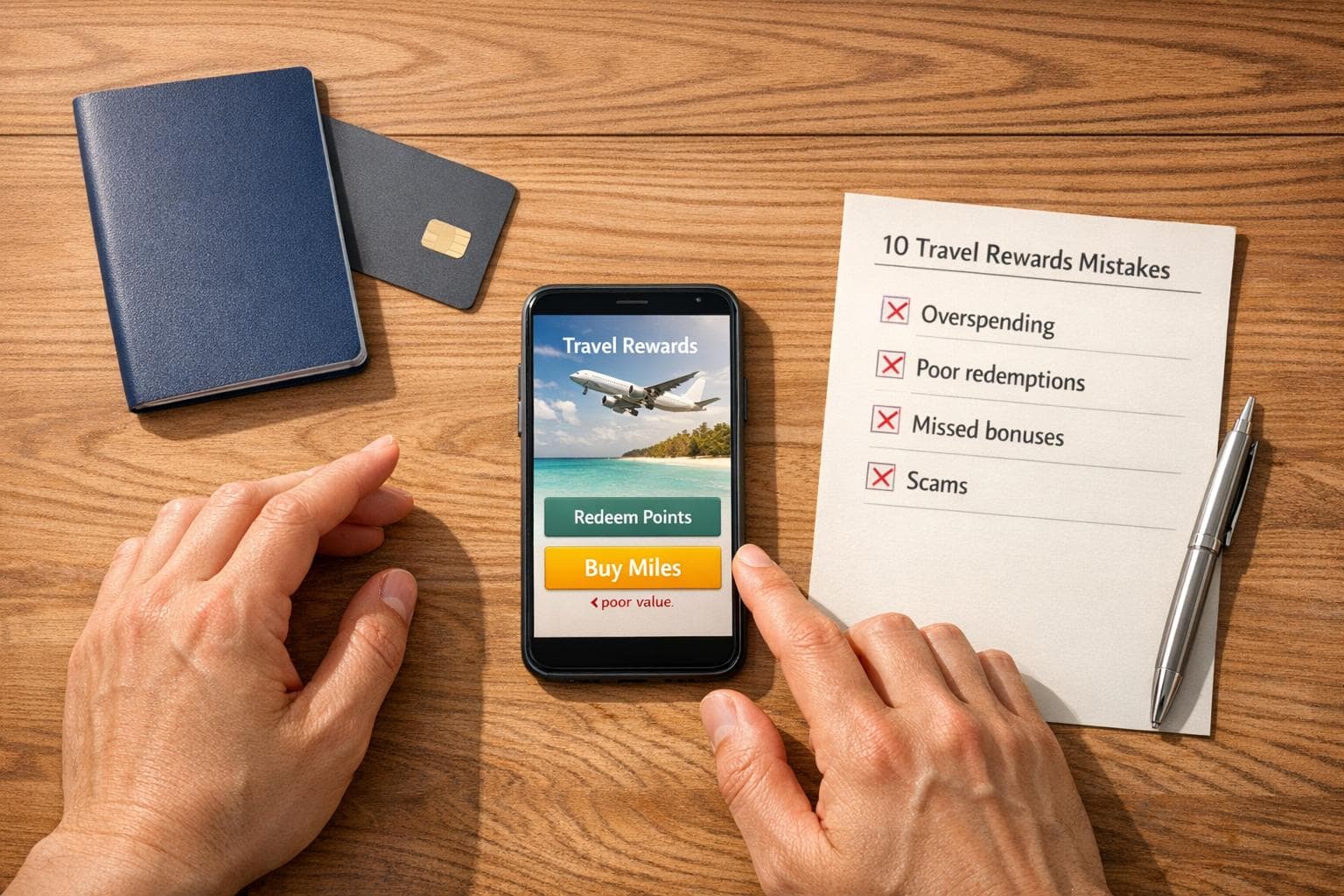
Travel rewards can save you hundreds or even thousands of pounds on flights, hotels, and more - if used wisely. However, many people lose out by falling into common traps. From overspending to meet sign-up bonuses to redeeming points poorly, these errors can cost you dearly. Here’s a quick breakdown of the biggest mistakes to avoid:
- Overspending for bonuses: Don’t stretch your budget to hit spending targets; unnecessary debt wipes out rewards.
- Settling for low sign-up bonuses: Wait for high-value offers to maximise your points.
- Focusing only on point quantity: Look at redemption value, not just the number of points.
- Redeeming points for merchandise: Travel redemptions often provide far better value.
- Buying miles directly: It’s rarely worth it unless there’s a significant promotion.
- Missing spending requirements: Plan ahead to secure sign-up bonuses without overspending.
- Using just one card: Diversify to protect against devaluation and gain flexibility.
- Ignoring flexible travel dates or airports: Adjusting plans can save points and money.
- Redeeming points for non-travel rewards: Travel redemptions usually offer the best return.
- Trusting unsolicited offers: Verify all deals to avoid scams and hidden fees.
The key takeaway? Use your points strategically and treat them as a currency that loses value over time. Plan your spending, stay flexible, and prioritise high-value redemptions to make the most of your travel rewards.
Travel Rewards Points Redemption Value Comparison Guide
STOP Wasting Your Points: 10 Mistakes to Avoid in 2025
sbb-itb-7ea9975
1. Overspending to Earn Sign-Up Bonuses
Sign-up bonuses can be incredibly enticing. For instance, a credit card might dangle an offer of 50,000 points if you spend £3,000 within the first three months. But here's the catch: if that amount surpasses your usual spending habits, you could end up with unnecessary debt. And with credit card interest rates averaging over 20%, the cost of borrowing can quickly eat away any rewards you earn.
"Even the most lucrative travel rewards are worthless if you're paying interest on your credit card balance".
The math rarely supports overspending. Carrying a balance just to hit the spending threshold often negates any bonus you might receive. So, how do you avoid falling into this trap? Start by reviewing your typical monthly expenses before applying for a new card. If the spending requirement is beyond what you usually spend, it’s probably not worth it. Instead, consider timing your application with necessary big-ticket purchases - like home repairs, new appliances, or annual insurance premiums. That way, you can meet the threshold without straining your budget.
Throughout the introductory period, keep a close eye on your spending to ensure you hit the target without overshooting or racking up interest charges.
As Zonia Mosciski DO, Chief Retail Officer, wisely points out:
"Points are a depreciating currency. Inflation, programme devaluations, and shifting partner policies can erode their value over time".
In short, chasing bonuses through unnecessary spending not only risks debt but also adds to the challenge of keeping up with the ever-changing value of rewards.
2. Accepting Low Sign-Up Bonuses
Sign-up bonuses can vary massively in value. The difference between a standard offer and a limited-time promotion can be huge - sometimes yielding double or even triple the points. Yet, many people jump at the first bonus they see without taking the time to assess its real value.
Take April 2026 as an example: the American Express Business Gold card offered a whopping 60,000 points for a £6,000 spend - three times its usual 20,000 points. Similarly, The Platinum Card increased its bonus to 75,000 points plus a £250 Amex Travel credit, compared to its standard 30,000 points. That’s a difference of 40,000 to 45,000 points, which could translate into hundreds of pounds’ worth of value, especially when redeemed strategically for premium travel like business class flights.
The problem with accepting a low bonus is the high opportunity cost. Many card issuers won’t let you earn the same bonus twice on the same card for a long time - sometimes months or even years. If you settle for a modest 20,000-point offer today, you might miss out on a far more lucrative 75,000-point deal that could appear next month.
"The industry relies on the majority of people using their miles 'badly', meaning that it can afford to leave sweet spots available for those who put in a bit of research".
So, what’s the best approach? Before applying for any rewards card, check loyalty news sites to understand the historical high bonuses for that card. Look for phrases like "increased offer" or "huge bonus." Entry-level cards might offer as little as 5,000 points, while premium cards during special promotions can go as high as 120,000 points. Also, make sure the spending requirement aligns with your normal budget - a 40,000-point bonus tied to a £5,000 spend over six months is only worthwhile if you can meet that target without overspending. Always compare current offers against historical promotions to ensure you’re getting the best deal.
3. Choosing Cards Based Only on Point Quantity
Basing your decision solely on a card's headline point offer can lead to missed opportunities when trying to maximise travel rewards. Sure, a card boasting 100,000 points may initially seem more appealing than one offering 50,000. But here's the catch: the value of those points depends heavily on how they can be redeemed. A high point total doesn’t always mean a high return if the redemption options are limited or poor.
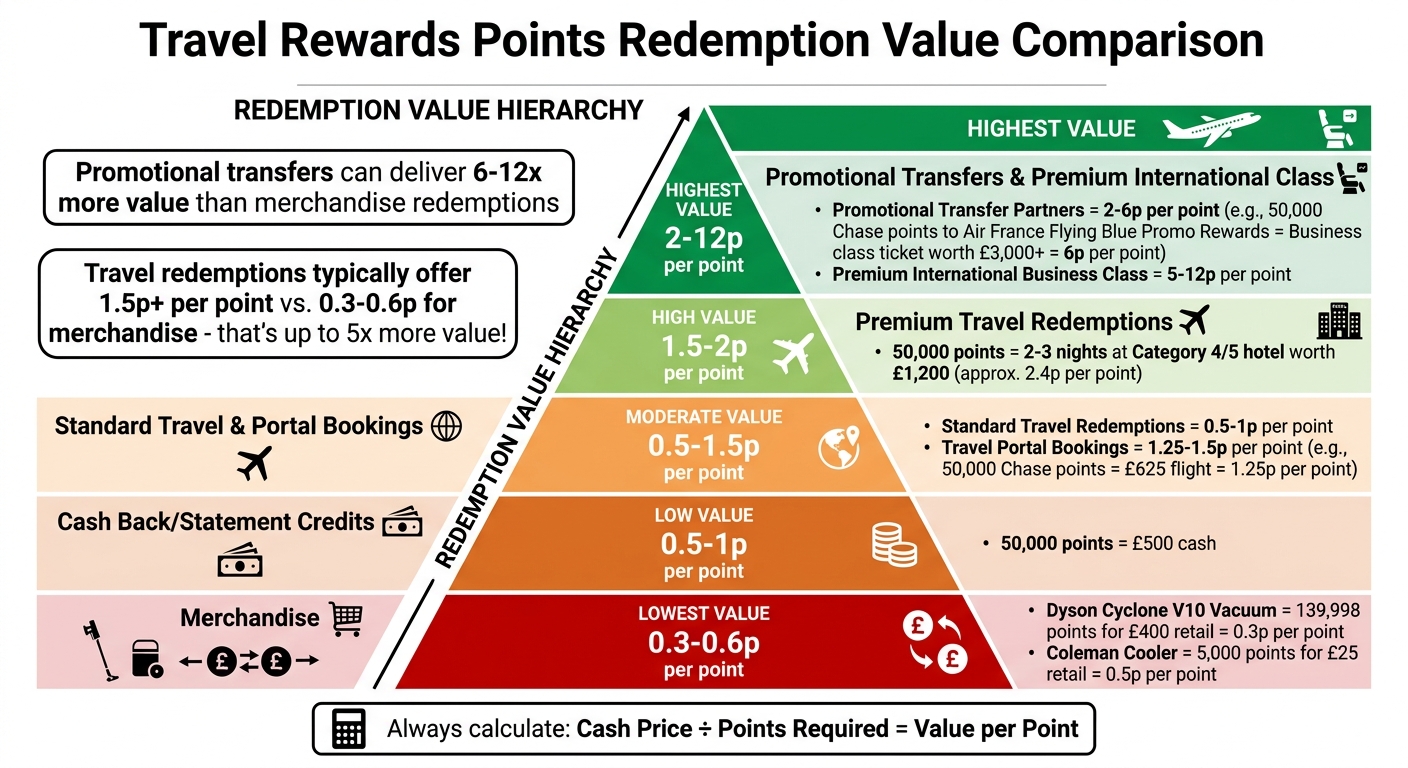
To put this into perspective, typical redemption values vary widely. Standard redemptions might yield only 0.5–1 pence per point, while travel portal bookings can push that up to 1.25–1.5 pence. However, the real magic happens during promotional transfers, where points can sometimes be worth 2–6 pence each. For instance, The Points Party Team shared an example from February 2026: using 50,000 Chase points through a travel portal could secure a flight worth about £625 (valuing each point at roughly 1.25 pence). But transferring those same points to the Air France Flying Blue programme during a Promo Rewards sale could unlock a round-trip business class ticket to Europe worth £3,000 or more - making each point worth around 6 pence. This highlights why understanding redemption rates and flexibility is key when evaluating a rewards programme.
Cards with flexible point currencies, like Chase Ultimate Rewards or Amex Membership Rewards, often provide better value than brand-specific points. These flexible points can be transferred to various partners, enabling you to find those "sweet spot" redemptions. Before committing to a card, take a closer look at its transfer partners, the transfer ratios, and the typical processing times (some transfers are instant, while others take 48 hours or more). Not all partners are created equal - some, like Hyatt and Air France/KLM, consistently offer excellent value, while others might struggle to deliver even 1 pence per point.
Another important factor to consider is the irreversible nature of most point transfers. Once you transfer points from your credit card to a partner programme, there’s no going back. This makes careful planning essential. Always confirm award availability before transferring points. As Oliver Hart, Senior Editor & Travel Rewards Strategist, wisely points out:
"Keep at least 20% of your transferable points liquid and only move them into airline/hotel programmes when you have a clear redemption in mind".
To avoid common pitfalls, calculate the cash value per point by dividing the travel cost by the required points. This ensures you're getting the best possible return. And one last tip: steer clear of using points for cash back or merchandise - these tend to offer the lowest value for your hard-earned rewards.
4. Redeeming Points for Catalogue Merchandise
Eyeing a shiny gadget in a rewards catalogue might be tempting, but using your points this way often gives you the least bang for your buck. On average, redeeming points for merchandise devalues them to less than 0.6p per point, while carefully planned travel redemptions can often fetch 1.5p or more per point. The numbers simply don’t add up, making catalogue redemptions a poor choice for maximising value.
Take this example: the Dyson Cyclone V10 Vacuum is listed on the Amex portal for 139,998 points. With a retail price of around £400, that works out to just 0.3p per point. Similarly, a Coleman 16-quart Cooler might cost 5,000 points, yet its retail price is under £25, giving a return of only about 0.5p per point. Personal finance writer Emily Starbuck Gerson sums it up perfectly:
"Merchandise is one of the worst ways to redeem reward points since items may be overvalued and offer less than a 1:1 return on your points”.
To avoid these low-value redemptions, do a quick calculation: divide the cash price of the item by the points required. If the result is less than 1p per point, it’s likely not worth it. Also, check prices at trusted UK retailers like Amazon or Argos to ensure the catalogue price hasn’t been inflated.
If you’re set on using points for non-travel purposes, gift cards are a better alternative. They usually offer a 1:1 ratio (e.g. 5,000 points for a £50 gift card), which is far more reasonable than most merchandise redemptions. However, the best strategy remains reserving your points for travel. Transferring them to airline or hotel partners can unlock values of 1.5p or more per point, giving you far greater returns. Keep this in mind as you plan your rewards strategy!
5. Buying Miles Directly from Airlines
Purchasing airline miles is almost never a good deal. Airlines typically charge between 2p and 3.5p per mile, while the average redemption value is only 1p to 1.5p. In simple terms, you're paying £2–£3 for a mile that's only worth £1. This mismatch means you're often overpaying, and that's before factoring in the risk of sudden devaluations.
The situation worsens when airlines unexpectedly devalue their points. For example, in late 2025, British Airways Club introduced a 10% increase in award pricing across the board. This change instantly reduced the value of purchased miles, leaving buyers at a loss. Because of this unpredictability, buying miles only makes sense during rare promotions offering substantial bonuses.
If you do decide to buy miles, timing is everything. Look out for limited-time offers with 50% to 100% bonuses, which can bring the cost down to around 1.5p per mile. At this price, it can make sense for premium redemptions, like Business or First Class flights. But even then, only buy miles when you’ve already found a specific flight with confirmed award availability. To make it worthwhile, ensure the redemption value is at least 1.5 times the cost of purchasing the miles.
A better approach? Focus on earning transferable points through credit card spending. Programmes like Amex Membership Rewards offer protection against devaluations by a single airline and give you flexibility when redemption values change. This aligns with the broader takeaway: instead of chasing quick fixes like buying miles, build a strategy around earning flexible points. Remember, miles are not assets to hold onto - they lose value over time. Treat them as a short-term currency and use them wisely.
6. Failing to Meet Minimum Spending Requirements
Missing the minimum spending requirement means losing out on your sign-up bonus entirely. These bonuses often range from 60,000 to over 100,000 points, translating to travel value between £600 and £2,000 or more. Even missing the deadline by a single day can cost you the entire reward.
"Missing that window by even a day means you forfeit the entire bonus. And given that welcome offers routinely range from 60,000 to 100,000+ points, worth £600 to £2,000 or more in travel, this is not a small mistake." – The Points Party Team
To avoid this costly mistake, careful planning is essential. While it’s important to meet the minimum spend, it’s equally crucial to stay within your budget to maximise your rewards without overspending.
Plan your spending strategically. Consider applying for a new card when you have high-value, planned expenses on the horizon. Examples include annual insurance premiums, home repairs, or holiday shopping. You could also prepay bills like your phone or internet for 3–6 months or switch monthly insurance payments to a single annual payment. If you find yourself slightly short of the target, buying gift cards for stores you frequently shop at - such as Amazon, Tesco, or Sainsbury’s - can help you meet the requirement without unnecessary spending.
However, resist the temptation to make unnecessary purchases or carry a balance just to hit the target. With credit card interest rates often exceeding 20%, the cost of interest can quickly outweigh the value of any rewards you earn. Keep a close eye on your spending during the first 90 days (most issuers start counting from the date your account is approved).
If you run a side hustle, using a business credit card could be an excellent option. Legitimate business expenses can count towards the spending requirement. Plus, many business cards from issuers like Chase, Citi, and Amex don’t factor into Chase’s 5/24 rule, giving you more flexibility without affecting your personal credit.
7. Sticking to Only One Rewards Card
Relying on just one rewards card can backfire, especially when loyalty programmes adjust their point values. Dynamic pricing and AI-driven changes frequently lead to devaluations. For example, a flight seat that cost 40,000 miles in 2021 might now require 60,000 miles, significantly reducing the value of your saved points overnight. Diversifying your cards can help cushion the impact of these unpredictable shifts.
"In 2026, the safest loyalty play is flexibility. Transferable points, a targeted status, and a short-seasonal playbook protect you from AI-driven award volatility." – traveltours Contributor
Having a mix of cards not only protects you but also enhances your options. Cards with transferable points allow you to move your rewards to the partner offering the best deal. At the same time, co-branded airline cards come with perks like lounge access, free checked baggage, and priority boarding - benefits that general rewards cards can't provide.
A smart strategy involves dividing your cards into three categories:
- Around 40% of your portfolio should focus on flexible, transferable currencies.
- About 30% should be dedicated to airline or hotel elite status cards.
- The remaining 30% should target seasonal or category-specific cards.
Choose cards that align with your spending habits. For instance, use a transferable points card for everyday purchases, an airline-branded card for flights to gain elite benefits, and a category-specific card for groceries or dining.
To stay on top of your rewards game, review your card portfolio every 6–12 months. Check balances, expiry dates, and transfer partners. If a card with an annual fee isn’t pulling its weight, consider cancelling it or downgrading to a no-fee version to avoid unnecessary expenses.
8. Ignoring Flexibility in Travel Dates and Airports
Sticking rigidly to specific travel dates and airports can often lead to unnecessarily high point redemptions. Airlines rely on AI-driven systems that adjust prices hourly based on real-time demand. This means the number of points needed for the same flight can vary dramatically depending on when you search. By staying flexible, you can sidestep these demand-driven price hikes and tap into saver-level award options that others might overlook.
One way to increase your chances of finding better deals is by broadening your airport choices. Consider airports within a 2-hour radius of your departure or arrival city. For example, if you're flying out of London, don’t limit yourself to Heathrow - check Stansted, Luton, and Gatwick as well. These secondary airports often have award seats unavailable at the main hub. The same logic applies to your destination; flying into a nearby secondary airport and completing your journey with a short ground transfer can result in significant savings.
Flexibility with travel dates can also unlock major benefits. Adjusting your trip by just a couple of days - especially flying on Tuesdays or Wednesdays - can lower the points required, as midweek demand tends to be lower. Similarly, travelling during shoulder seasons, which fall between peak and off-peak periods, can lead to noticeable discounts compared to trips during major holidays. Even small adjustments like these can stretch the value of your reward points considerably.
"Airfare is volatile. It's not ever a singular price." – Katy Nastro, Spokesperson, Going
For even greater savings, tools like Tripaway can be invaluable. These platforms scan millions of flight options to uncover hidden deals, mistake fares, and flash sales that can slash airfare costs by 40–90%. Mistake fares, often caused by pricing errors, can offer incredible discounts - sometimes over 85% on long-haul flights. For example, a typical New York to Paris route costing £500–£750 might drop to just £70–£125 during such a pricing error. The catch? These deals are fleeting, often disappearing within 24–72 hours, so quick action is essential.
9. Redeeming Points for Non-Travel Rewards
Using points for non-travel rewards might seem convenient, but it often delivers poor value compared to travel redemptions. For instance, redeeming points for gift cards or merchandise usually results in low returns. Cashback or statement credits typically provide only 0.5 to 1 pence per point, while transferring points to airline or hotel partners can yield significantly more - sometimes up to 5 pence per point.
Let’s break it down. If you have 50,000 Chase points, redeeming them for cash at 1p per point gives you £500. However, transferring those same points to a travel partner could secure 2–3 nights at a Category 4 or 5 hotel, potentially worth up to £1,200. Similarly, while 50,000 points might cover a flight worth £625 through a portal, transferring them during a promotion could boost their value to over £3,000.
"For everyone else, cash back is the lowest-value exit for your points." – The Points Party Team
Before opting for something like an Amazon gift card, calculate how much value you’re actually getting. Merchandise redemptions often yield just 0.5–0.8 pence per point. On the other hand, premium travel redemptions - like international business class tickets - can provide returns as high as 5–12 pence per point. Cash redemptions might only make sense if you’re dealing with high-interest debt or have no travel plans in the near future.
To get the most out of your points, use tools like Point.Me or Seats.Aero to compare redemption options across different travel programmes. Always confirm award availability for your preferred dates before transferring flexible points to a travel partner, as such transfers are irreversible. By keeping these strategies in mind, you can maximise the value of your points for travel-related rewards.
10. Trusting Unsolicited Bonus Offers
Those unexpected bonus offers popping up in your inbox or as online ads might seem irresistible, but they often come with hidden dangers. Scammers frequently craft fake websites that look like legitimate travel rewards programmes to steal your login details or payment information. Even offers that seem legitimate can use deceptive discounts or rewards to lure you in, only to hit you with unexpected fees or altered terms. This is why it's crucial to approach such offers with caution and verify them directly.
To stay safe, always confirm unexpected offers through official channels. Instead of clicking on links in emails, log in directly to your credit card issuer's website or app and check the "Special Offers" or "Rewards" sections. Alternatively, contact the loyalty programme's official customer service to confirm the legitimacy of the offer. You can also cross-reference the bonus details with "best current offers" lists on trusted travel rewards websites to see if they match known promotions.
"Transparency isn't in the airline industry's DNA. The more opaque the pricing, the more control they have - and the less power you have as a traveler." – Aviation Policy Analyst
Be on the lookout for warning signs like unusually high spending requirements, unclear privacy policies, or pushy upselling tactics. Legitimate high-value bonuses are usually tied to specific, clearly announced start and end dates. For example, authentic Amex promotions ending on 26 May 2026 include detailed spending thresholds and timeframes. If an offer is vague about how your data will be used or seems too perfect, it’s likely a red flag. Always consider any associated fees to determine the real value of the offer.
Conclusion
Travel rewards programmes can help you save money, but they only work well if you avoid common mistakes and stick to a clear rewards strategy. The sheer volume of unredeemed points highlights how many travellers miss out on their rewards' full potential.
The key to success is treating your points as perishable assets rather than something to hold onto indefinitely. Points lose value over time due to inevitable devaluations, so it’s smart to set specific redemption goals, prioritise transferable points for added flexibility, and use them before their value diminishes.
Additionally, getting the most from your rewards often means shopping around. Don’t just rely on airline websites - compare transfer partners to find the best redemption options. Tools like Tripaway can be a game-changer, helping you spot hidden price drops or mistake fares. This could cut airfare costs by 40–90%, letting you stretch your points further or save them for premium travel experiences.
Tying everything together, a disciplined approach is essential. Strategies like avoiding unnecessary spending and maximising redemptions only work if you also steer clear of credit card interest rates that can exceed 20%. Pay off your balances, avoid extra fees, and never overspend just to chase bonuses. With careful planning and the right tools, you can consistently get more value from every pound spent and every mile flown.
FAQs
How do I meet a sign-up bonus without overspending?
To earn a sign-up bonus without stretching your budget, it's all about planning. Most bonuses require spending between £1,000 and £3,000 within a set period. Focus on necessary purchases - things you already planned to buy. Keep an eye on your spending progress to ensure you meet the deadline without scrambling at the last minute.
One crucial tip: always pay off your credit card balance in full each month. If you don’t, the interest charges could outweigh the value of the bonus you’re working towards. Stay disciplined, and you’ll make the most of the rewards without any financial headaches.
What’s a good pence-per-point value in the UK?
In the UK, a solid redemption value for points is typically around 1p per point. To get the most out of your points, try to aim for this rate or higher. Anything less than 1p per point is usually not worth it, so it's always a good idea to double-check the redemption rates before spending your points.
When should I transfer points to airline or hotel partners?
When it comes to transferring points to airline or hotel partners, timing is everything. It's best to do so when you have a specific redemption in mind and want to get the most value out of your points. Before making the transfer, take a moment to review your accounts. Check your current balances, keep an eye on expiry dates, and confirm which transfer partners are available.
This approach is particularly helpful for high-value redemptions or if you're looking to avoid letting points sit unused. With travel costs on the rise and the potential for points to lose their value over time, making strategic transfers can help you stay ahead.